Archive for August 30, 2013

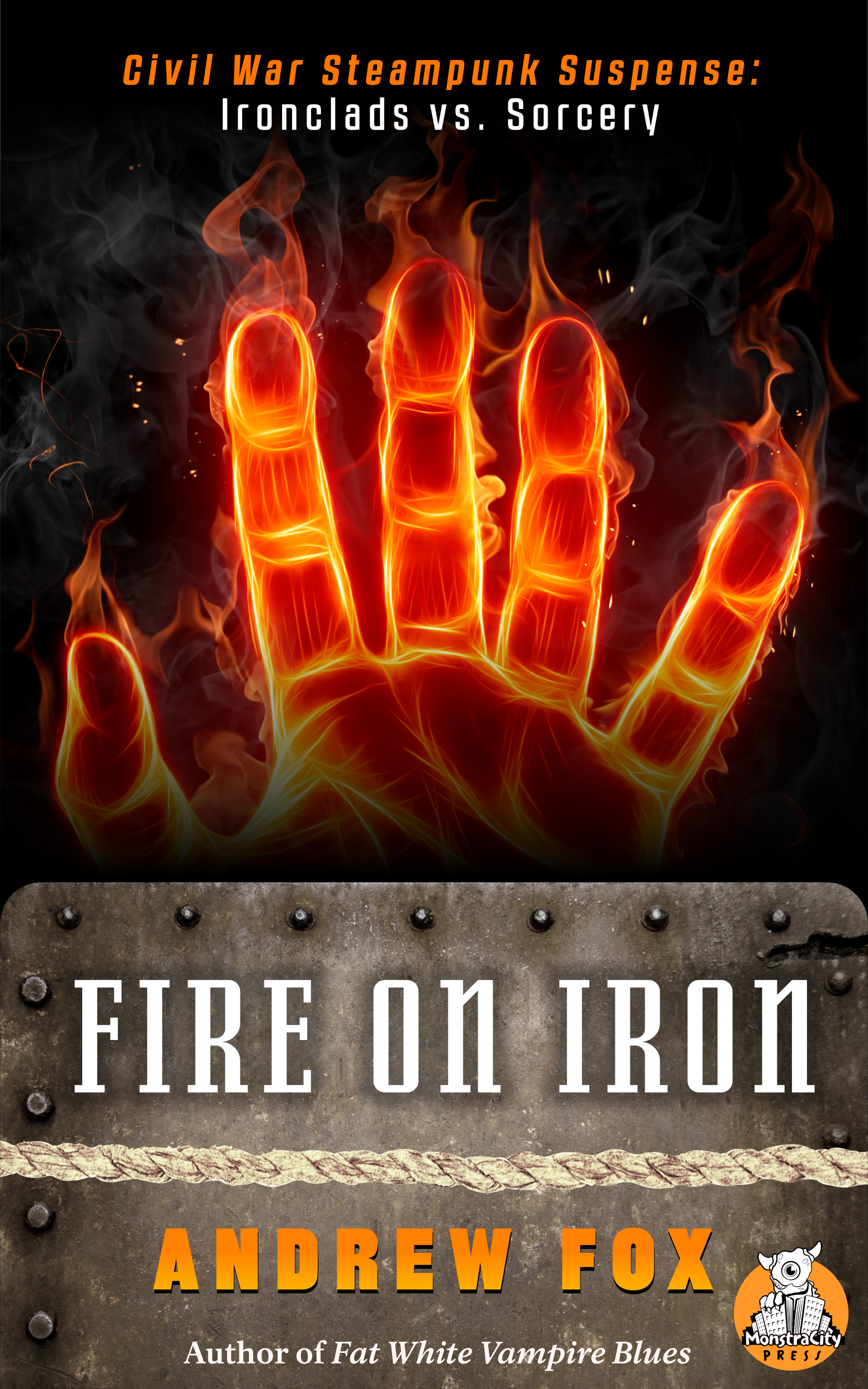
Fire on Iron Coming in October!

I am very, VERY pleased to announce that the first book to be published by MonstraCity Press will be my steampunk supernatural suspense novel, Fire on Iron. It will be available in all the popular ebook formats and as a trade paperback this October. The first of many projects to come from MonstraCity Press!

Here is the back cover copy:

“What price redemption? Is martial honor worth the cost of one’s soul?

“Lieutenant Commander August Micholson lost his first ship, the wooden frigate USS Northport, in reckless battle against the rebel ironclad ram CSS Virginia. However, Flag Officer Andrew Foote offers the disgraced young Micholson a chance to redeem himself: he can take the ironclad gunboat USS James B. Eads on an undercover mission to destroy a hidden rebel boat yard, where a fleet of powerful ironclads is being constructed which will allow the Confederate Navy to dominate the Mississippi.

“But dangers far more sinister than rebel ironclads await Micholson and his crew. On the dark waters of the Yazoo River, deep within rebel territory, they become entangled in a plot devised by a slave and his master to summon African fire spirits to annihilate the Federal armies. Micholson must battle devils both internal and external to save the lives of his crew, sink the Confederate fleet, and foil the arcane conspiracy. Ultimately, Micholson is faced with a terrible choice — he can risk the lives of every inhabitant of America, both Union and Confederate, or destroy himself by merging with a demon and forever melding his own soul with that of his greatest enemy.

“Book 1 of Midnight’s Inferno: the August Micholson Chronicles

I believe my protagonist August Micholson will be rather unique – a steampunk amalgam of Dr. Strange and the Human Torch, with a great deal of multiple-personality complications mixed in. My next project will be the second book in the Midnight’s Inferno series.

More news to come, both regarding the Midnight’s Inferno books and other exciting projects from MonstraCity Press – so watch this space!

Snapshot of the Revolution in Book Retailing, Circa 1978

Upheaval in the bookselling trade is not a purely 21st century phenomenon. The introduction of cheap paperbacks during the decade following World War Two turned the bookselling trade upside down, pushing the locus of the trade away from small shops located in big city downtowns to newsstands and drugstores, with their ubiquitous spinner racks. Cheap paperbacks helped (along with the introduction of TV into nearly all households) to kill off the formerly lucrative niche of pulp fiction magazine publishing; many of the specialty pulps disappeared altogether (nurse pulps, airwar pulps, and western pulps, to name a few), and the science fiction and mystery pulps shrank back to a handful of titles, the survivors soon reducing their format to the smaller (and cheaper to manufacture and distribute) digest size.

More recently, in the middle to late 1970s, the bookselling trade was transformed yet again, this time by the rapid spread of shopping mall-based national and regional bookstore chains which concentrated on carrying large selections of paperbacks and discounted hardbacks, most of the latter being “remainders,” unsold books which had been returned by stores and then offered by their publishers for resale at steeply discounted prices.

I came across this Time Magazine article from 1978, entitled “Rambunctious Revival of Books,” which gives a sepia-toned portrait of the bookselling trade thirty-five years ago, before the rise of the superstores, when mall-based chains such as Waldenbooks and B. Dalton Booksellers were the Amazon.coms/800-pound gorillas of their day. (Note: This article is brought to you by the Internet Archive Way-Back Machine, so it may take an extra few seconds to load.)

“Once upon a time book retailing was about as exciting as watching haircuts. Hardcover books were often sold in musty downtown stores by fussy bibliophiles, and many readers turned to paperback racks in the more informal atmosphere of supermarkets or drugstores. Today the bookstore business is in the midst of a rambunctious revival. … Largely as a result of their merchandising razzle-dazzle, the chains are inducing people to buy more books than ever. … Helped by the chains’ expansion, stores are springing up, increasing from about 7,300 less than two years ago to almost 9,000 now.

“In the forefront of the merchandising blitz are such chains as Waldenbooks, the nation’s largest book retailer, owned by Carter Hawley Hale Stores. Begun in 1962, the Walden chain now has 498 shops dotted around the country, mostly in suburban shopping malls. In recent years it has been opening a store a week. B. Dalton, a subsidiary of Dayton Hudson Corp., the department store conglomerate, is the second largest bookseller. Dalton too has been growing at a feverish rate in recent years and has 339 stores in 40 states. Other chains include Doubleday stores, an affiliate of the publishing house, and Brentano’s, an affiliate of Macmillan. The chains account for up to half of all hardcover retail sales, and their share of the market grows every month.

“These big companies operate with a cold efficiency that astounds the oldtime booksellers, who often take a warm proprietary interest in their wares. Highly computerized Dalton, which carries about 30,000 titles in each shop, assigns every book a number; when the book is sold the number is entered through the cash register into a computer, which produces a weekly report on what every store in the chain has sold. Slow-moving titles are quickly culled. Most chains concentrate almost exclusively on bestsellers—novels, selfhelp, biographies and the like. …

“Kroch’s, which has a reputation as a quality bookseller with an interest in the literary field, continues to operate in the old tradition; its sales people, for instance, often phone customers to alert them to new books that they might like. Against this, Dalton offers a plethora of autograph parties featuring such guests as Charlton Heston and former Treasury Secretary William Simon, and some selective discounting. Like many independents, Carl Kroch, the chain’s president, insists there will always be a place for the old, full-price shop. Says he: ‘You can’t provide our kind of services on such a large scale. Besides, there’s room for everyone. The public is still underexposed to books.’”

The modern reader has to stifle a laugh at the article’s swooning description of “highly computerized Dalton … (which) assigns every book a number.” Wow! What a wonder of the modern world! But the words of Carl Kroch sound much less dated – because they echo virtually every press release sent out by Leonard Riggio, Barnes and Noble’s chairman, whose firm, the only surviving national superstore chain in America, now finds itself in precisely the same market position as Kroch’s Books was in back in 1978.

Still, this article inspired a lot of nostalgia for me. I was thirteen years old in 1978, what Isaac Asimov has called “the Golden Age of science fiction.” It certainly was for me. I had just discovered Anne McCaffrey, Robert Silverberg, and Ursula K. LeGuin. I began building my science fiction reference library at my local Waldenbooks, tucked away inside the 163rd Street Shopping Center in North Miami Beach, spending my weekly allowance and bar-mitzvah gift money on such tomes as The Visual Encyclopedia of Science Fiction and David Kyle’s wonderful pair of beautifully illustrated, large-format histories, A Pictorial History of Science Fiction and The Illustrated Book of Science Fiction Ideas and Dreams (still own all three of them and have been sharing them with my oldest son). That particular Waldenbooks, by the way, was where I met the first, great (unrequited) love of my life, a cultured young lady seven years my senior who was working as a bookstore clerk to pay her way through college. The nearest B. Dalton Bookseller was downtown, at the Miami Omni Mall; due to their well-stocked history section, that was my go-to source for big, thick, photo-choked histories of warships and armored vehicles. Four years later, when I went to New Orleans to attend Loyola University, I discovered a Brentano’s Books at the Shops at Canal Place mall, located downtown near the Mississippi River; it was a charming spot at which to enjoy a cappuccino and page through an imported art book.

I imagine that come 2048, thirty-five years from now, some other commentator will come across an article in the Internet Archive Way-Back Machine (or its future equivalent) from Forbes or The Wall Street Journal or Wired, describing the disruptive impact of Amazon on the bookselling trade and the death-throes of the physical superstores. I wonder whether that middle-aged commentator will look back on his or her teen book-buying years and remember the experience of shopping on Amazon with the warm glow of nostalgia?

A The Frisky Article Which Should Appeal to a Certain Plus-Sized Vampire

Perusing the Internets, I came across a link to an evocatively entitled article, “Girl Talk: How Having Sex With a Fat Guy Changed Me.” Before you all go scurrying off to follow the link yourselves, let me warn you that (as with many articles I’ve encountered at this site) the title promises a pay-off way, way beyond what the article itself delivers. I believe this is called “link bait.” (Hey, it works; I’m linking.)

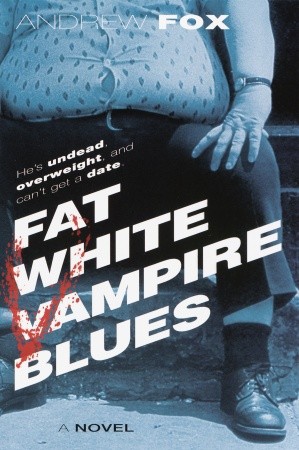
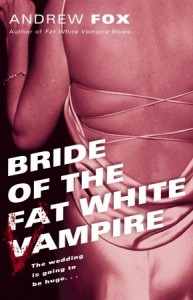
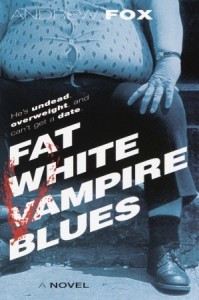
Anyway, the couple of minutes I spent reading this rather disappointingly limp article got me thinking of great “link bait” titles for other articles in this vein, titles the editors of The Frisky might come up with after a few nights spent in bed with copies of Fat White Vampire Blues and Bride of the Fat White Vampire. Here are a few suggestions:

How Watching a Fat Man Transform Himself into 180 Plump White Rats Changed My Feelings About Rodents

How Being Fed Three Quarters of the Menu at Ralph’s Po-Boys Emporium by a Nosferatu of Size Changed My Opinions of Moderately Priced New Orleans Restaurants

How Being Forced to Imagine a Fat, Starving Vampire Change Himself into a Wolf, Scarf Down Three Bags of Stolen Dog Chow, and Then Have Unintentional Doggy-Style Sex with a Stray Mutt Changed My Inclination to Donate to the SPCA’s Spaying and Neutering Fund

How Reading the Tales of a Washed-Up, 450-Pound Vampire Bragging About His Glory Days as a Masked Superhero During World War Two Changed My Willingness to Tolerate Cross-Genre Experiments by First-Time Novelists

Are you listening, Frisky editors? Link bait like this doesn’t come along every day, y’know.

Karen Black Dies Too Soon to Play Jules Duchon’s Mother in Fat White Vampire Blues Movie

Fly that 747, Karen! From AIRPORT 1975

Yesterday, August, 8, 2013, Hollywood lost one of its most versatile and memorably quirky character actresses, Karen Black. Ms. Black passed away at the age of 74 following a two-year battle against cancer.
She originally earned a name for herself playing unforgettable supporting parts in prominent Hollywood films such as Easy Rider (1969), Five Easy Pieces (1970), The Great Gatsby (1974), and Nashville (1975). She was nominated for a Supporting Actress Oscar for her role as Jack Nicholson’s sleazy girlfriend in Five Easy Pieces. She also did live theater, performing in both Broadway and Off-Broadway productions, including the drama Come Back to the Five and Dime, Jimmy Dean, Jimmy Dean in 1982, which was directed by her Nashville director, Robert Altman.

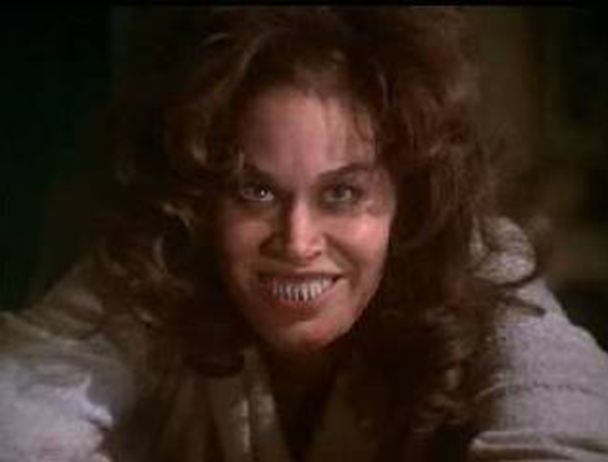
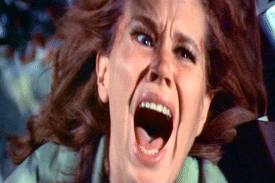
However, to her bemused dismay (as expressed in this interview with the Chicago Tribune), she suspected the role she would be best remembered for would be that of Amelia in the third segment of the classic made-for-TV horror anthology movie, Trilogy of Terror (1975). In one of the most indelible TV performances of the 1970s, Ms. Black played a single apartment dweller who unwisely brings a Zuni fetish doll home as a tchotke, only to discover that it has a disturbing tendency to become ambulatory and hunt… most savagely.
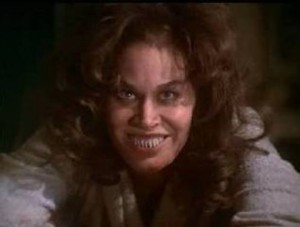
My, what nice TEETH you have, Karen… From her never-to-be-forgotten TRILOGY OF TERROR

Following her triple performance in Trilogy of Terror, she continued working very steadily, but the mix of her movies tended more and more towards horror and the macabre. Over the next three decades, she would carve out a reputation as one of Hollywood’s premiere low-budget scream queens. She starred in a score of horror and science fiction pictures from the mid-1970s to the first decade of the new millennium, oftentimes, as she grew older, playing the eccentric mother of the movie’s protagonist. Here’s a list of Karen Black movies which would appeal to the Midnight Movie set:

Burnt Offerings (1976) – a big-budget haunted house film starring Bette Davis (Whatever Happened to Baby Jane?), Oliver Reed (Curse of the Werewolf), and Burgess Meredith (Rocky)

The Strange Possession of Mrs. Oliver (1977) – made for TV horror pic

Capricorn One (1978) – conspiracy-minded thriller about the government falsification of a manned journey to Mars (starring O.J. Simpson)

Killer Fish (1979) – an Italian rip-off of Jaws, featuring Lee Majors (The Six Million Dollar Man) versus piranhas

The Blue Man (1985) – a.k.a. Eternal Evil, a supernatural thriller about astral projection

Cut and Run (1985) – Italian “cannibals in the jungle” thriller

It’s Alive III: Island of the Alive (1986) – the cannibal baby returns (again with the cannibals?)

Invaders From Mars (1986) – Tobe Hooper’s remake of the 1953 low-budget cult SF film

The Invisible Kid (1988) – a comedy about, well, an invisible kid

Out of the Dark (1989) – an “erotic comedy horror film” and Divine’s last role before his/her death (sounds right up my alley!)

Mirror, Mirror (1990) – a horror film also starring Yvonne De Carlo of The Munsters fame

Evil Spirits (1990) – Karen runs a boarding house for misfits; kills them off and collects their government checks; woo-hoo!

Zapped Again! (1990) – a high school kid with psychokinetic powers versus the Key Club; direct-to-video (are you surprised?)

Children of the Night (1991) – vampire thriller

Haunting Fear (1991) – supernatural thriller about a woman with a phobia of being buried alive

Plan 10 from Outer Space (1994) – apparently has no connection, plot-wise or otherwise, with Ed Wood’s Plan Nine from Outer Space; instead, a science fictional spoof of Mormonism(!)

Children of the Corn IV: The Gathering (1996) – the first installment in the series to go straight-to-video

Teknolust (2002) – a SF thriller about a scientist (played by Tilda Swinton, so memorable in Orlando) who clones herself and spreads viruses throughout both the computer and male populations

Curse of the Forty-Niner (2003) – a.k.a. Miner’s Massacre (between the two titles, kinda self-explanatory)

House of 1000 Corpses (2003) – homage to the splatter films of the 1970s; Rob Zombie’s directorial debut

Suffering Man’s Charity (2007) – a.k.a. Ghost Writer, a comedy horror film about a would-be writer who kills a real writer so he can lay claim to the dead man’s script (what an incredibly lousy initial title)

Mind you, the films I’ve listed above form only a portion of Ms. Black’s workload during those decades. Along with all the horror dreck, she continued to perform in slice-of-life dramas and off-beat independent films.

In her 2008 interview with the Chicago Tribune, Ms. Black reflected back on the “horror-ble” turn her career took following her performance in Trilogy of Terror:

“Q: You’ve done all types of films, from Five Easy Pieces to horror films such as House of 1,000 Corpses. But why do you think horror directors have been drawn to you?

“A: Scary movies I’ve done — there have been about 14 out of 175. They are not dominant in any way, shape or form. I can tell you what happened, but it was sort of like a mistake. It’s like I went on a bad path and couldn’t find my way back. Being remembered for it is only interesting when you measure it against the few films I’ve done of the genre. When I did Trilogy of Terror, with that [demon] doll, I filled the role very well. It was very real to people, and they just fell in love with it. And that got to be incredibly popular. With my last name being Black… so it got to be kind of an unconscious thing, [my association with horror movies]. But I’m not interested in blood.

“If this latest film I’m in, The Blue Tooth Virgin, were seen all across the country rather than Rob Zombie’s movies, I’d be remembered differently. It’s chance. It’s too bad. But frankly, I’m not that bothered by it because of the plays and movies I’m doing now.”

Well, Karen, it’s better to be remembered than not to be remembered, I suppose. I’ll always remember you for your roles in Five Easy Pieces and Trilogy of Terror.

Oh, what a Dorothy Edna Duchon you would’ve made, Karen!

But why, oh why couldn’t you have hung in there just a few years longer? Someday, somebody’s going to make a movie version of Fat White Vampire Blues. And you, Karen Black, could have played Dorothy Edna Duchon, obese vampire Jules Duchon’s mother, like no other scream queen alive or dead.