Archive for April 30, 2012

Visit to Harpers Ferry, WV (part 1)

Canada geese on a shoal in the Shenandoah

A "gargoyle", part of the remains of an old mill, overlooks the Shenandoah River

Several weeks ago my family and I visited a place that should be on the destination list of any day-tripper in the Mid-Atlantic region with an interest in American history and/or spectacular scenery – Harpers Ferry, West Virginia. This nearly 250-year-old town, whose compact 0.6 square mile is split between a National Historical Park and a Historic District, is located at the confluence of the Potomac and Shenandoah rivers, where three states meet: Virginia, West Virginia, and Maryland. It was the site of one of two original United States Armories, of John Brown’s antislavery raid in 1859, and of a major Civil War battle which resulted in the surrender of a larger number United States troops than at any time in history, prior to the surrender on the Bataan Peninsula in 1942. The town changed hands eight times during the Civil War, which resulted in the destruction of much of its considerable industrial infrastructure. That infrastructure was subsequently almost completely obliterated by the great flood of 1870, only one of numerous ruinous floods which swept through the area during the nineteenth and early twentieth centuries.

Shells on a Shenandoah River beach

Parking in the Lower Town area of Harpers Ferry, site of the John Brown Monument, the remains of the Federal Armory and Arsenal, the Amtrak station, and restaurants and attractions, is very limited, so most visitors will want to pay the $10 admission fee to the Harpers Ferry National Historical Park, which boasts ample parking located a mile and a half away, beyond Virginius Island and up Bolivar Heights. Every fifteen minutes, a comfortable bus ferries visitors to a stop just outside Lower Town, near the northern tip of Virginius Island, which sits in the Shenandoah River.

No one lives on Virginius Island now. The last inhabitants fled after the record flood of 1936. What remain on Virginius Island are the ruins of numerous nineteenth century mills and factories, all of which took advantage of the power provided by the Shenandoah River. The National Parks Service is currently engaged in archeological excavations (which, ironically, suffered severe setbacks during two floods in December, 1996) to preserve the ruins and to interpret the economic, industrial, and residential life of the thirteen-acre island.

Levi, Judah, and me standing beneath an archway of an old mill

This is gorgeous spot in which to spend an hour or two of quiet contemplation (not that I was able to have too much of that, needing to keep an eye on three boys). On the far side of the Shenandoah River from the island are the Loudoun Heights of Virginia, beautiful tree-lined hills teeming with birds. Several sets of mild rapids dot the river adjacent to the island, and one doesn’t have to stand on its shore for very long before seeing kayakers or rafters. The sandy shore of the river is sprinkled with colorful clam shells, and various types of ducks and geese frequently land on the river’s shoals and small islands. The sounds of traffic from the road on the Virginia side are muted and add to, rather than detract from, one’s contemplative mood.

Firehouse that served as John Brown's "fort"

Virginius Island, the former industrial district of Harpers Ferry, is a short walk from Lower Town. Part of the Harpers Ferry National Historical Park, Lower Town features a book store, a museum of nineteenth century industry, and reproductions of Civil War era clothing and sundries shops. It is also the site of the John Brown Memorial and the fire engine house, originally next door to the Federal Armory, which Brown and his followers took refuge in while under siege by a contingent of U.S. Marines temporarily commanded by future Confederal General Robert E. Lee (then a lieutenant colonel and, although on leave, the senior officer closest to Harpers Ferry when Brown attacked the Armory).

Lower Town section of Harpers Ferry

During the late nineteenth century, after war and floods had displaced or destroyed most of the town’s heavy industry, Harpers Ferry became a fashionable summer resort for several decades, hosting many prominent visitors from Washington, DC and Baltimore, including President Woodrow Wilson. The Baltimore and Ohio Railroad operated an amusement park, called Island Park, on a piece of land that jutted out into the Potomac River. However, the Great Depression and the great flood of March 18-19, 1936, when the rivers crested at 36.5 feet at Harpers Ferry, the all-time record, ended the resort trade in the town.

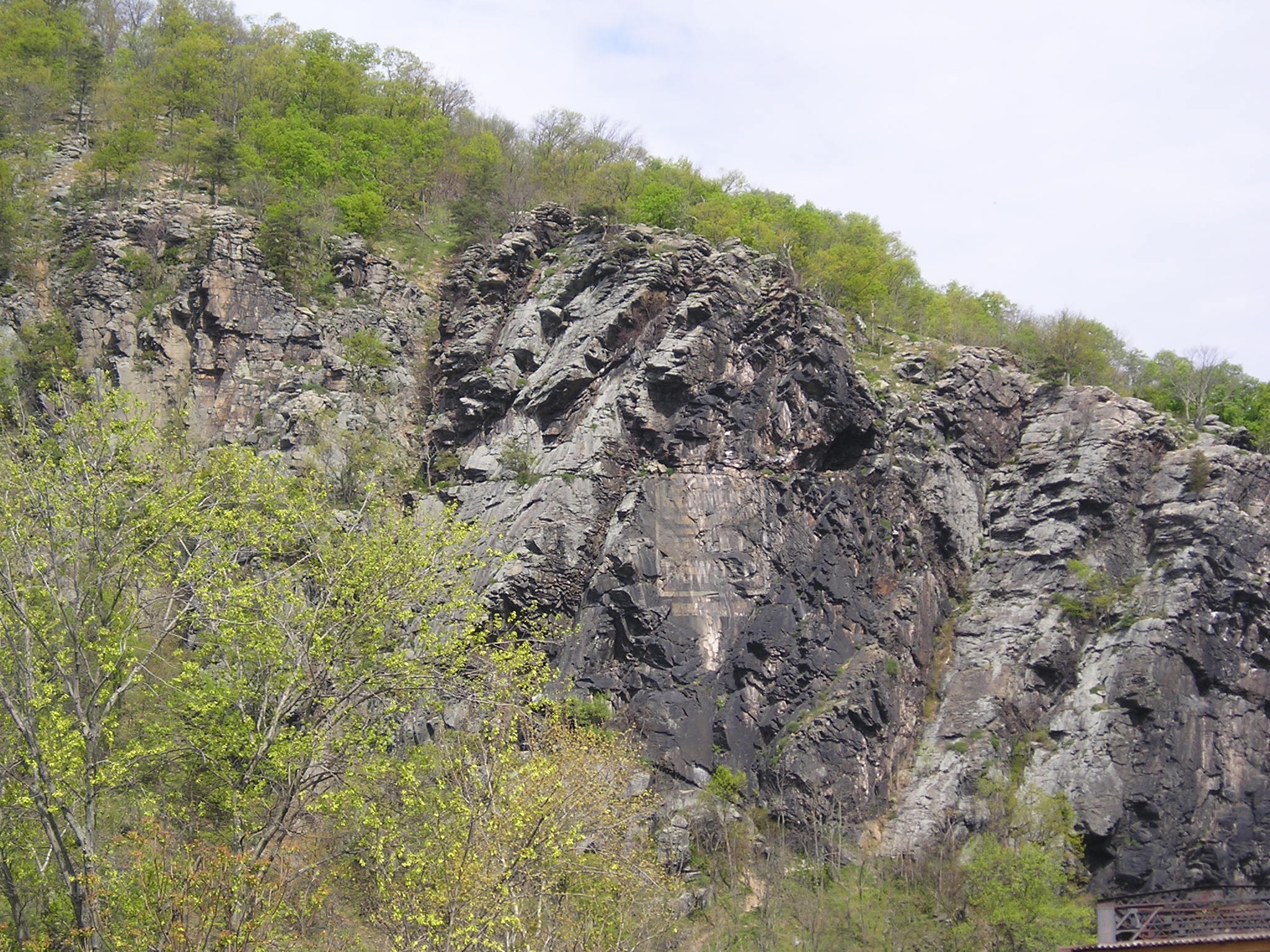
The site of the old U.S. Armory and Arsenal, destroyed during the Civil War, is located between the Harpers Ferry Amtrak Station and a pair of railroad bridges, including the historic B & O Railroad Potomac River Crossing. On the far side of the Potomac from the old armory lies Maryland Heights. The Heights are pierced by a railroad tunnel, and a cliff face of naked shale still holds an early twentieth century advertisement for borated toilet powder (whatever the heck that was!).

Rocky bluff across the Potomac from Lower Town

More photos to come!

Worst Giant Ape Film of All Time? Konga vs. The Mighty Peking Man

Since I started writing this blog back in July, 2011, my youngest son, Judah, has become a giant monster fanatic (a chip off the old block; I adored all the same stuff at his age). My first “favorite movie” was King Kong Vs. Godzilla, which even at the age of six was a guilty pleasure for me, because I had seen the original King Kong and knew in my heart-of-hearts that Toho’s man in a gorilla suit could not compare to Willis O’Brien’s stop-motion animated Kong. Still, hokey as that guy in a gorilla suit seemed, I couldn’t resist the sheer fun of seeing Japan’s biggest, baddest radioactive dinosaur rumble with King Kong (who gained kind-of-cool electrical powers in the film, a bit of an equalizer to Godzilla’s radioactive breath).

Judah loves all the Godzilla films, from the classics and near-classics (Godzilla, King of the Monsters and Godzilla Vs. the Thing, a.k.a. Godzilla vs. Mothra) to the really “awful” ones (Godzilla’s Revenge, thought by many to be the worst Godzilla film of all, but one which Judah and I both appreciate). He also really digs other giant monster films, favorites including The Deadly Mantis, Tarantula, the Gamera movies of the 1960s and 1970s, and South Korea’s only foray into the genre, Yongary, Monster From the Deep. He has even sat through the Mystery Theater 3000 version of The Giant Gila Monster, although the point of the snarking robots at the bottom of the screen escaped him.

Being five, he will happily watch his favorites over and over again (and I’ll generally comply with his pleas to watch with him, since many of those films never get old for me), but I do my best to “broaden his horizons” and introduce him to films he hasn’t seen before. Netflix is a great help with this parental mission. I saw that Konga, a 1961 collaboration between a British studio, Anglo Amalgamated, and an American studio, American International Pictures, was available for instant streaming. I hadn’t seen Konga since I was a kid, and my memories of the film were somewhat hazy. Still, it had a giant ape in it, rampaging through London, so I figured, what’s not to like?

Plenty, as it turned out. Interestingly, the big ape, Konga, was by far the worst thing about the film. The rest of the movie deserved a better monster. Somewhat unusually for a 1960s giant monster flick, the human performances are quite good, making the very lame FX and ape acting seem all the more limp by comparison. Michael Gough is very memorable as the increasingly deranged Professor Charles Decker, the scientist who mutates a friendly little chimpanzee, Konga, into a massive brute by injecting him with several doses of growth serum. Margo Johns is equally as good as Margaret, Decker’s lab assistant, who, in love with her boss, blackmails him into marrying her by agreeing to go along with his dangerous experiments and utilization of Konga to murder his academic and scientific rivals. The scenes between them crackle with dramatic tension, especially after Barbara learns of Decker’s horndog yearnings for Sandra (Claire Gordon), his young, pretty student.
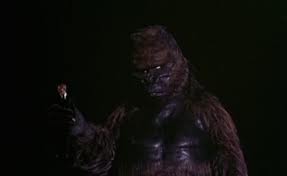
"If you hadn't injected me with this damn growth formula, I could have stayed a lively little chimp, instead of a comatose giant gorilla!"

Where the film completely falls flat on its face is whenever the ape shows up. Oh, Konga is perfectly acceptable so long as he remains a chimp, portrayed by an actual chimpanzee. But once he is mutated into a full-grown gorilla, he is a black hole on the screen, sucking all of the film’s verisimilitude and audience involvement out and depositing them in some nether region on the far side of the galaxy. Simply put, aside (maybe) from some gorilla portrayals in Republic Pictures or Monogram Studios serials of the 1930s and 1940s, uncredited actor Paul Stockman delivers the most lackadaisical, unconvincing portrayal of a gorilla by a man in a gorilla suit on film. (Stockman has thirteen film and TV credits, none of the others being apes; his only named characters are Inspector Dales in two 1967 episodes of the TV series Adventures of the Seaspray and Steve Parker in Dr. Blood’s Coffin, made the same year as Konga, 1961.) George Barrows rented his gorilla suit to the makers of Konga; the suit had previously appeared in such cinema “classics” as Gorilla at Large and Robot Monster. They would have done as well to stuff a mannequin inside the gorilla suit as put Paul Stockman in there. Stockman makes no effort whatsoever to portray a gorilla. He simply walks around inside the suit, with all the verve and dynamism of a man trying to wipe a wad of chewing gum off the bottom of his shoe onto a patch of grass. Before being turned gigantic by Barbara’s final injection of the growth serum, Konga is directed by Decker to murder three of his rivals. None of the strangulation murders are filmed with any suspense, interesting camera angles, or cinematic energy at all. Stockman as Konga goes through the motions, as though Decker had sent him out to the local pharmacy for some antacid tablets.

Perhaps the film’s biggest surprise is that Konga, who grows to more than a hundred feet tall, doesn’t destroy anything, beyond his initial big growth spurt wherein he shoots through the roof of Decker’s house and stumbles through his greenhouse filled with carnivorous plants. He shambles through the outskirts and then the heart of London and somehow manages to avoid wrecking so much as a single building, smooshing a single civilian (apart from Barbara, whom he tosses to the carnivorous plants, and Decker, whom he flings to the soldiers as though he were discarding a candy wrapper), or trampling a single infantryman. I picture a little two-way radio inside the mask of Stockman’s gorilla suit, with the director constantly warning him, “Mind the budget, you! We can’t afford even a single mangled model car!”
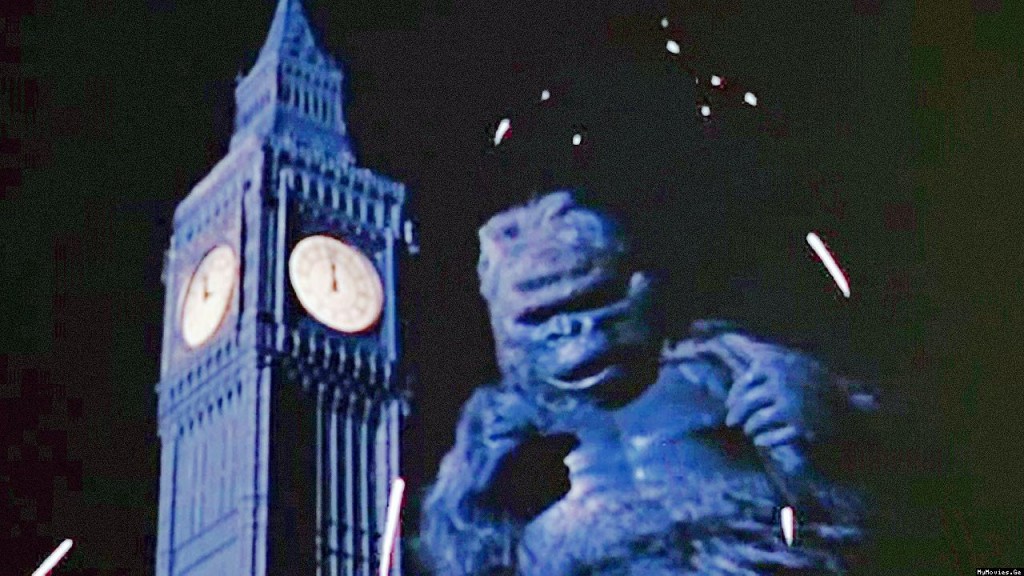
The British Army's marksmanship has sadly declined since the glory days of El Alamein

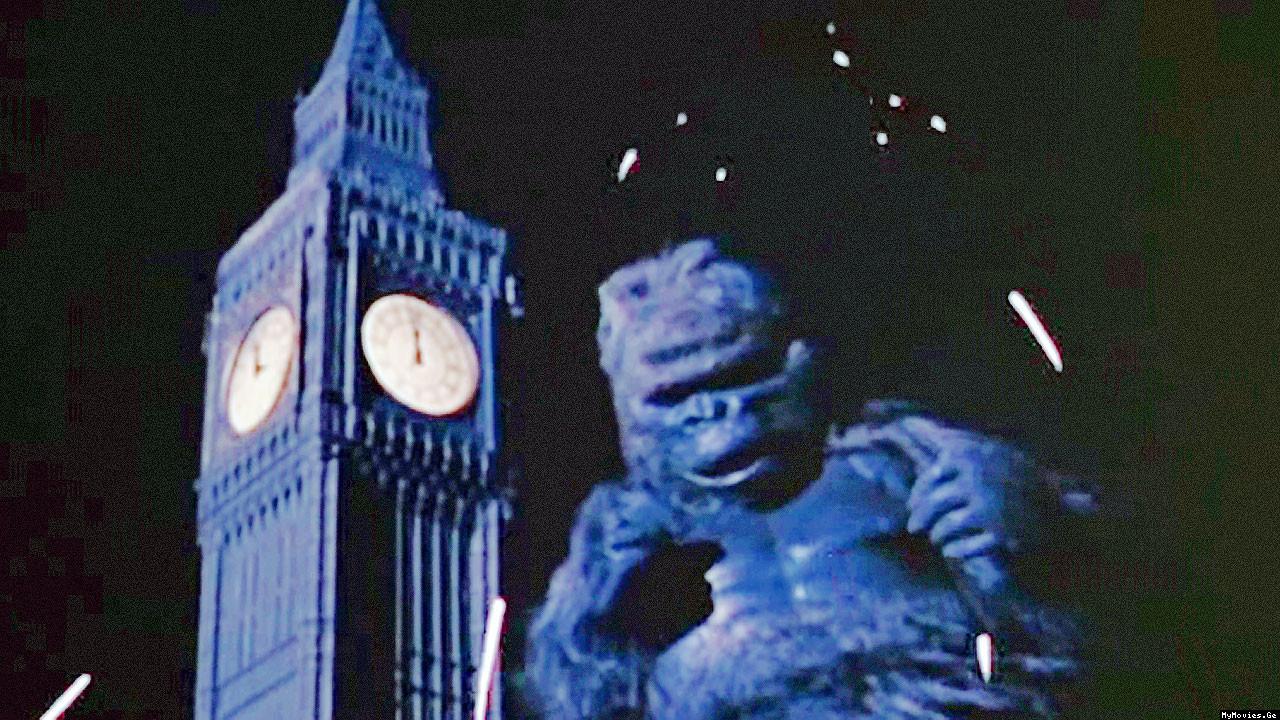
Accordingly, none of the several dozen extras hired to run away from the giant ape appear to be in much of a hurry or evince much in the way of terror. “Big ponce won’t spend the effort to step on me,” seems to be the general attitude. When the British Army arrives on the scene, they don’t bother moving the crowds back, as though they are unconcerned by the possibility that a few dozen folks might get trampled or have their heads removed by a stray bullet. Speaking of stray bullets, the Nazi Propaganda Ministry of WWII couldn’t have done a more effective job of denigrating the deadliness of Britain’s armed forces than the makers of Konga. As Konga – over a hundred feet tall, mind you, not a small target – poses immobile next to London’s Big Ben, the assembled infantrymen fire several hundred rounds of tracer bullets and rockets at the giant gorilla, from a range of perhaps fifty yards. Every single tracer shell sails harmlessly over the ape’s head or shoulders. Finally, once the filmmakers have apparently grown tired of this incredible display of ineffectuality, and with Stockman in the gorilla suit just standing there and waving an improperly scaled doll of Professor Decker limply through the air, the Army men correct their aim and bring the big gorilla down. The closing shot, the big climax? Through the magic of a blur filter being placed in front of the camera lens, the giant gorilla shrinks back to his original form – which turns out to be a stuffed toy chimp bought from the local toy store. They couldn’t have sedated an actual live monkey for the shot, or at least used a miniature that doesn’t look like it belongs in an infant’s nursery? Supposedly the special effects, among the first giant monster effects to be filmed in color (although Ray Harryhausen had done it to immeasurably greater effect three years earlier with his The 7th Voyage of Sinbad), took eighteen months to complete. What did they do in all that time? Obviously not build miniatures capable of fooling even a three-year-old.
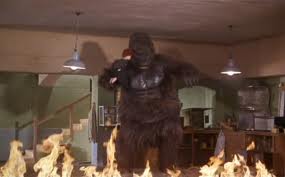
FX horror or horrible FX? Willis O'Brien rolls over in his grave

The most cringe-inducing FX shot comes right after Barbara gives Konga his super-sized injection of growth serum. We get that blur filter again, and Konga shoots up to about twelve feet tall, tall enough to fill much of Decker’s laboratory. He picks up Barbara in his expanded paw – and she is obviously a two-foot-tall doll, of the kind little girls get for Christmas so they can practice styling its hair with miniature plastic brushes. This shot doesn’t last a half-second, which might have ameliorated its awfulness, but a full four or five seconds, which can’t help but make the most casual viewer wonder if the filmmakers were even trying. The worst traveling matte effect would have been an improvement over this travesty – Ed Wood-level filmmaking, but without Ed Wood’s unintentional humor.
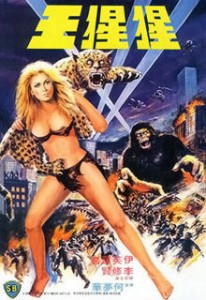
Beauty and the beast, Hong Kong-style

After Konga (thankfully) came to an inglorious end, Netflix, as it is wont to do, suggested a handful of similar films I might enjoy. One of them was a giant ape-man movie I had never heard of, a 1977 Hong Kong production called The Mighty Peking Man. Oh, what fun! I told my son and my wife. This sounds even worse than Konga! We can have a competition to decide the worst giant ape movie of all time! And so we settled in for the second entry in our inadvertent double feature.

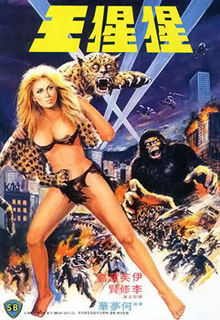
I went into The Mighty Peking Man with no preconceptions whatsoever – aside from an expectation that it would be cheesy and generally awful, judging solely from its awkward title and the year of its filming (1977 was simply not a golden year for pop culture). This turned out to be a delightful way to watch this movie, as virtually every five minutes brought a fresh surprise and gasp of appreciation for the momentous heights of fantabulous cheesiness scaled by this film. A little history is in order. The Shaw Brothers Studio in Hong Kong rushed The Mighty Peking Man into production to capitalize on the worldwide giant gorilla craze sparked by Dino De Laurentiis’ 1976 remake of King Kong, which introduced moviegoers to Jessica Lange. The picture, starring Danny Lee as an archeologist/adventurer and blonde bombshell Evelyn Kraft as a female Tarzan named Samantha, wasn’t released in the U.S. market until 1980, under the title Goliathon. However, nineteen years later, in 1999, this obscure film got a second release in the U.S. market, this time under its original name, thanks to the efforts of Quentin Tarantino, who worked with Miramax to rerelease it through his Rolling Thunder Pictures distribution company. At which point it earned a grand total of $17,368.00 in the theaters before being swept away into the Blockbuster bins. I can only assume it has performed somewhat better on home video and cable TV. It certainly deserves to be seen.
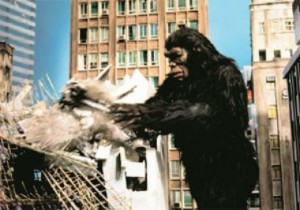
Mighty Peking Man, unlike Konga, delivers the goods

From beginning to end, this movie is a hoot to watch, without a dull moment. It displays, in spades, all the cinematic energy which the “horror” scenes of Konga so miserably lack. All the atmospherics work in its favor – its disco-era costuming and soundtrack, as well as its performers’ extroverted acting styles, give it the feel of a Blaxploitation film without Black people (which I’m sure helped to endear it to Quentin Tarantino, that famed fanboy of Blaxploitation). Plus, the filmmakers take the hint of flirtatiousness between Jessica Lange’s Dwan and Rick Baker’s Kong from the hit movie of the prior year and dial it up to eleven, going where no giant ape movie had gone before. Kuang Ni, the scriptwriter, combines the stories of King Kong and Tarzan. Rather than the Great White Hunter/Filmmaker bringing his Blonde Goddess to the Giant Gorilla’s lair, in this instance, a Great Asian Archeologist discovers a Blonde Tarzanna already comfortably ensconced with the giant ape-man in the Himalayan wilderness. Samantha’s parents had perished in a small plane crash near the home of the Mighty Peking Man, and the giant ape-man rescued the tiny child from the wreck and raised her, somehow providing her with a skin-tight animal-skin bikini to wear. Samantha has the ability to communicate with all the large animals in her domain, including leopards and tigers, and she is quite… uh, familiar with the Mighty Peking Man, who she calls Utam. There are a couple of scenes wherein she climbs into Utam’s giant paw and sinuously rubs her pneumatic body up and down his big index finger, as tall as she is, up and down, up and down, those big breasts, barely contained by that animal-skin bikini top, giving Utam a voluptuous manicure… well, I’m sure you get the idea. Sailed right over Judah’s little head, but not my wife’s head. Or my head. Jesus, I need a cold shower after typing that…
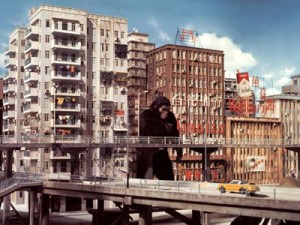
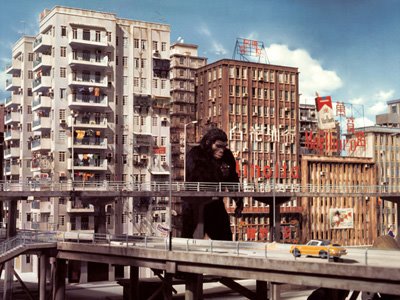
Mighty Peking Man's miniatures put those of Konga to shame

Alas, things do not end well for Samantha and her Utam. Archeologist Johnny, doing his best Carl Denham imitation, drags them away from their jungle paradise across the South China Sea so that Utam can be put on public display in Hong Kong. Utam puts up with this in amiable fashion until one of the film’s heavies takes a rude interest in comely Samantha and attempts to rape her – in a hotel room with an open window that just happens to be overlooking the stadium where Utam, in chains, is watching. Utam, to put it mildly, does not take this lying down. Sadamasa Arikawa and Koichi Kawakita, the special effects directors, then put on a hell of a good show. Their miniatures of downtown Hong Kong rival the best 1950s and 1960s work of Toho Studios and are superior to the model work deployed by Daiei Motion Picture Company in their 1960s Gamera movies. The Mighty Peking Man costume is very ugly, reminiscent of the green gargantua costume used in Toho’s 1966 War of the Gargantuas, but the effects men manage to make the mask express a wide range of emotions, and the actor in the suit uses his body language about as effectively and expressively as Haruo Nakajima does as Kong in King Kong Escapes or as Shoichi Hirose does as Kong in King Kong vs. Godzilla — all three giant ape performances being head and shoulders above Paul Stockman’s shameless sleepwalking through Konga. In a revealing parallel with the English-American coproduction, Utam throws his tormentor, Samantha’s would-be rapist, to the ground, just as Konga tosses Decker to the street – only the vastly more energetic Mighty Peking Man then crushes his victim with his giant foot.

Once the closing credits rolled, my supposed contest for the worst giant ape movie of all time ended up as no contest at all. The Hong Kong production is far and away the better movie (Judah and Asher both agreed). Are there any other giant ape movies out there that can rival Konga for wretchedness? I’ve already mentioned the Toho trio of giant ape movies, War of the Gargantuas and the two Kong flicks. I would place them all above Konga due to the quality of their miniature work, the expressive suit performances delivered by their gorilla actors, and their never-boring, endearingly goofy antics and plot turns. I would be tempted to pit Dino De Laurentiss’ King Kong against Konga for the title, since I truly disliked that film, even as a kid, but the high quality of Rick Baker’s performance as Kong uplifts his film and gives it the edge (had De Laurentiss been able to stick with his original plan to solely utilize his life-size King Kong robot for the Kong performance, then we would have a real contest on our hands).
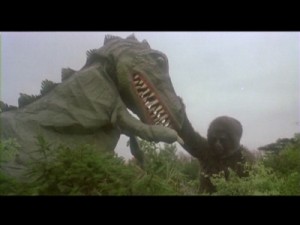
QUEEN KONG, which is also in the running for Least Convincing Portrayal of a Dinosaur on Film

I’ve never seen Queen Kong, a 1976 British comedy which got embroiled in a lawsuit with Dino De Laurentiss and never received a general theatrical release, appearing only in limited release in Germany and Italy. Apparently the film has a cult following in Japan, where it has received entirely new Japanese dialogue, done in the spirit of Woody Allen’s What’s Up, Tiger Lilly?. Sadly, neither version of Queen Kong is available on Netflix. The photos and screen grabs I’ve been able to view online look truly dreadful, so this one might be credible competition for Konga.
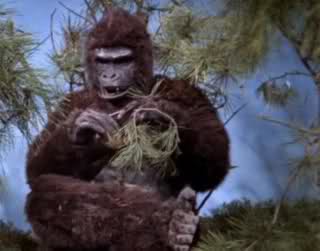
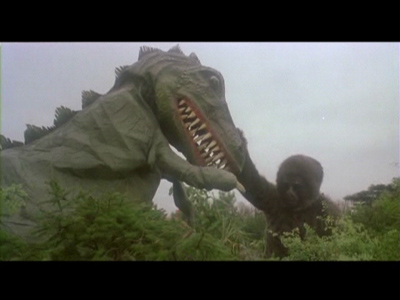
A*P*E, South Korea's entry in the Worst Giant Ape Movie of All Time competition

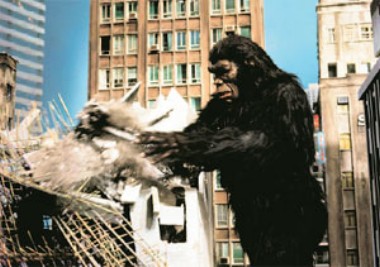
I also hear that a South Korean production, A*P*E (1976), made, like The Mighty Peking Man, to gobble up some of the box office crumbs left over from the De Laurentiss King Kong, is epically bad. Judge for yourself from the pair of “special” FX photos I’ve so kindly provided.
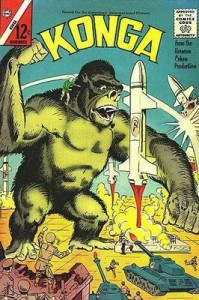
An adaptation much superior to the original

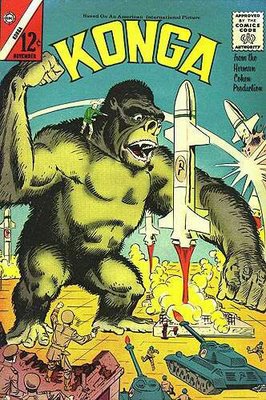
Konga did not sleepwalk in vain, however. This wretched film spawned a far superior offspring in a different medium – Charlton Comics’ 1960-66 comic book series Konga, illustrated by Steve Ditko, the co-creator of Spider-Man. In Konga, Ditko found a character perfectly suited to his unique style of illustration (I would argue that Konga is a better fit for Ditko’s style than even Spider-Man). He took a character virtually devoid of expressive qualities (see my comments above concerning Paul Stockman’s “performance” as Konga) and made him, by turns, whimsical, affectionate, lovelorn, lonely, playful, affronted, and vengeful.
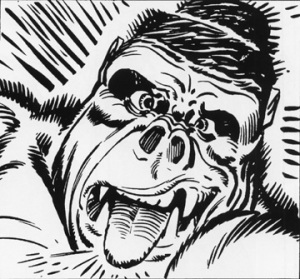
Yes, the comics version had 500% more personality than the movie original

The series was popular enough to last twenty-four issues (the final issue was retitled Fantastic Giants), and it spawned a spinoff miniseries and two companion monster series at Charlton, Gorgo and Reptilicus, both also illustrated by Steve Ditko. Highlights of the series have recently been reprinted in the black and white collection, The Lonely One, which offers terrific reproductions of Ditko’s line art without the distraction of the inferior, crude coloring common to comic books of the 1960s. The stories are absolutely charming and are gorgeous to look at. I highly recommend hunting down either the original comics or the reprint collection.

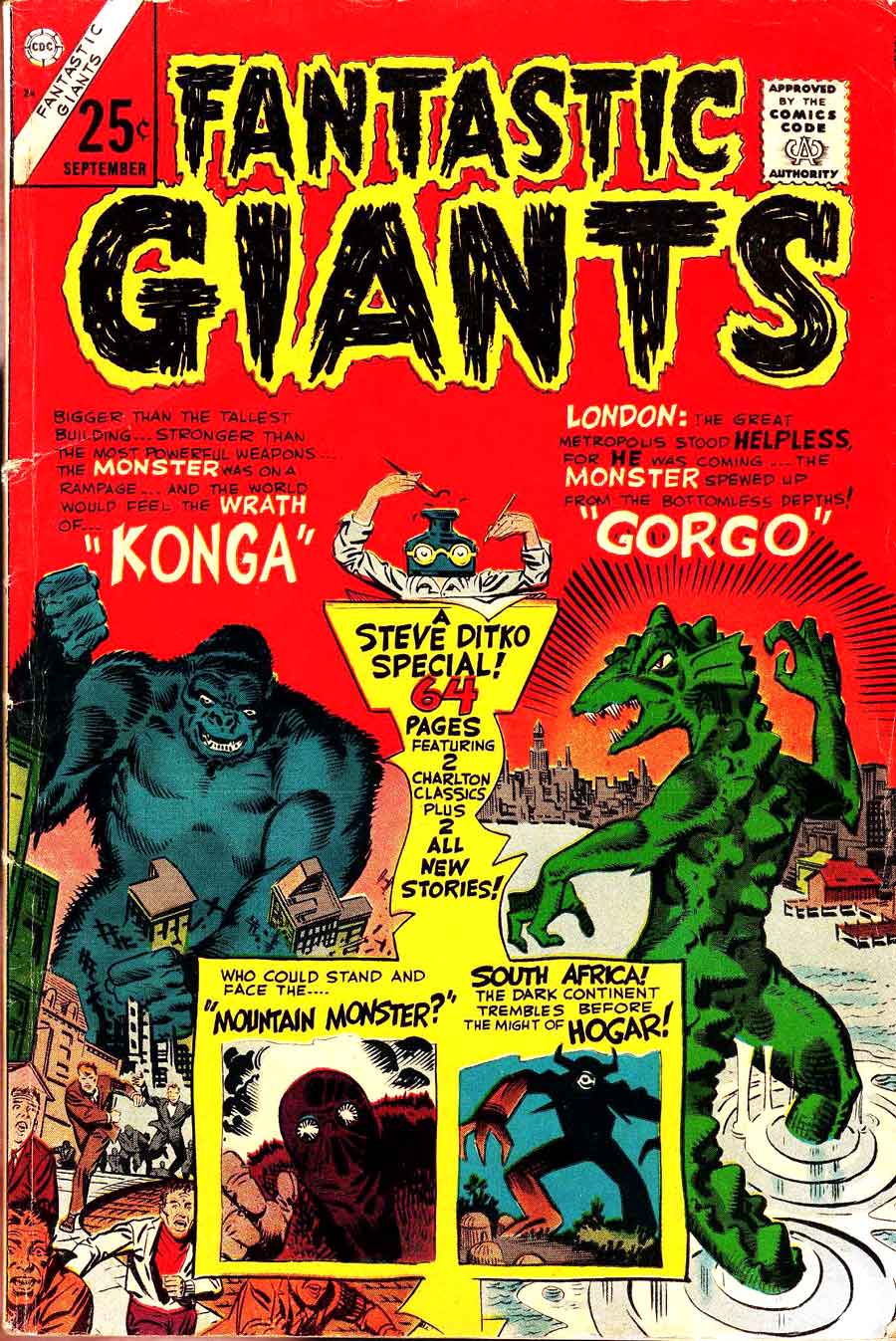
Even though the final issue of Konga (actually Fantastic Giants) came out when I was a year old, I ended up with a copy as a young boy. My dad worked in a cardboard box factory, and the boxes were made from recycled paper. Knowing how much I loved comic books, he gave instructions to the workers on the factory floor that if they ever saw a comic heading for the shredding machine, they should pull it out and bring it to him. That’s how I ended up with a coverless copy of Fantastic Giants #24, which reprinted the origin stories of Konga and Gorgo, plus two new giant monster stories by Steve Ditko. How I loved that big, fat, 64-page comic! I virtually read it to pieces. I loved it so much that I drew my own cover for it to replace the cover it had lost. Thanks to the magic of the Internet, the real cover of Fantastic Giants #24 is reproduced below:
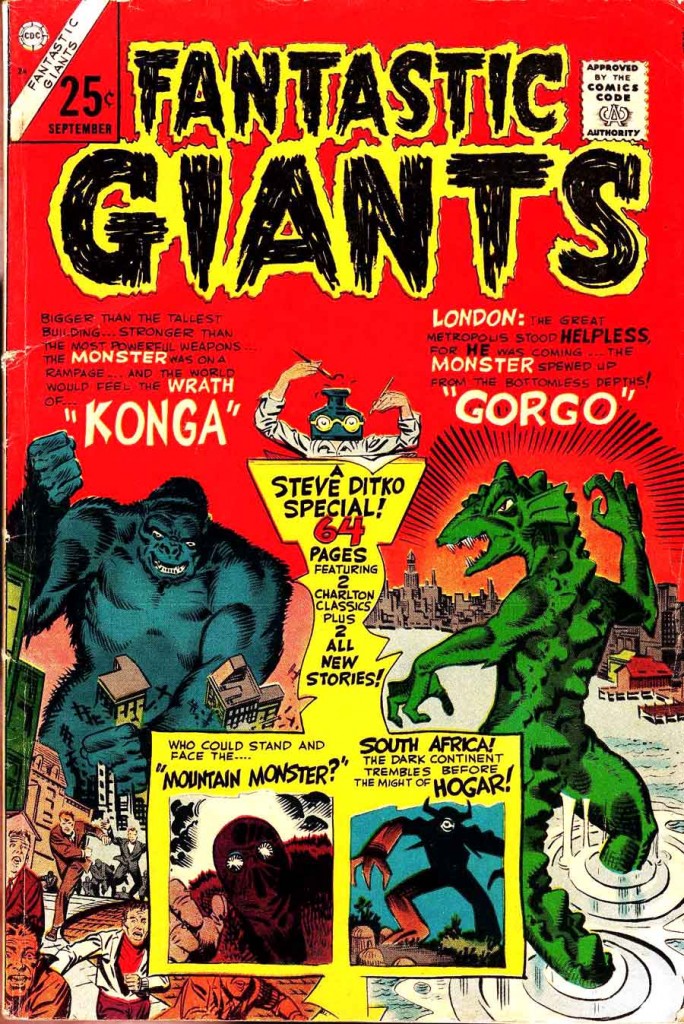
Oodles of fantastic Steve Ditko art for only a quarter!

For those of you who are big fans of Charlton’s monster movie comics of the 1960s, here’s a link to the mother of all reference articles on the subject, a treasure trove of arcane trivia. Enjoy!
New Interview Online

Levi and me at RavenCon in Richmond, VA

Mark Covington of the James River Writers group recently did an interview with me that he posted on the group’s site. The James River Writers group, centered in Richmond, Virginia, is a terrific organization which sponsors monthly readings and signings for regional writers and numerous workshops and social events. Here’s an excerpt from the interview, some comments about my daily writing routine:

“I do nearly all of my writing on my commuter train to and from my job in Washington, D.C. Before moving to Northern Virginia, I did all my writing in coffee shops. Having a cup of coffee handy is helpful.

“Also very helpful is writing on an old laptop or palmtop computer which doesn’t provide access to the Internet. I know myself too well; if I were to try writing on a computer which had Internet access, I would spend 90% of my writing time screwing around.

“I used to head into large projects with firm notions of only how to begin the book and how to end it. However, I’ve found that to be a dangerous system for me because I tend to over-write a good bit. If I don’t plot out my middle, I can easily end up taking a couple of years writing a 200,000 word manuscript which I then have to cut back by 40%. So, nowadays, I outline my books rather thoroughly before starting them. I allow myself to wander away from my outline whenever my imagination heads me in another direction, but I like having the outline there as a safety rope.”

Pohl + Kornbluth Part 7: Wolfbane

Return to Introduction
Return to The Space Merchants
Return to Search the Sky
Return to Two Solo Novels: The Syndic and Drunkard’s Walk
Return to Gladiator-at-Law
Return to the Collaborative Short Fiction

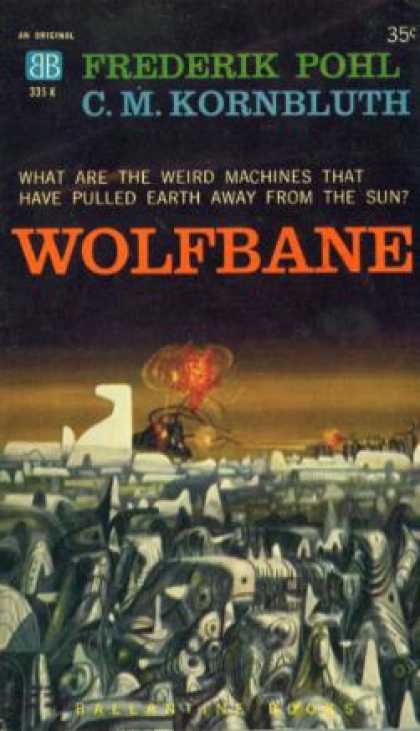
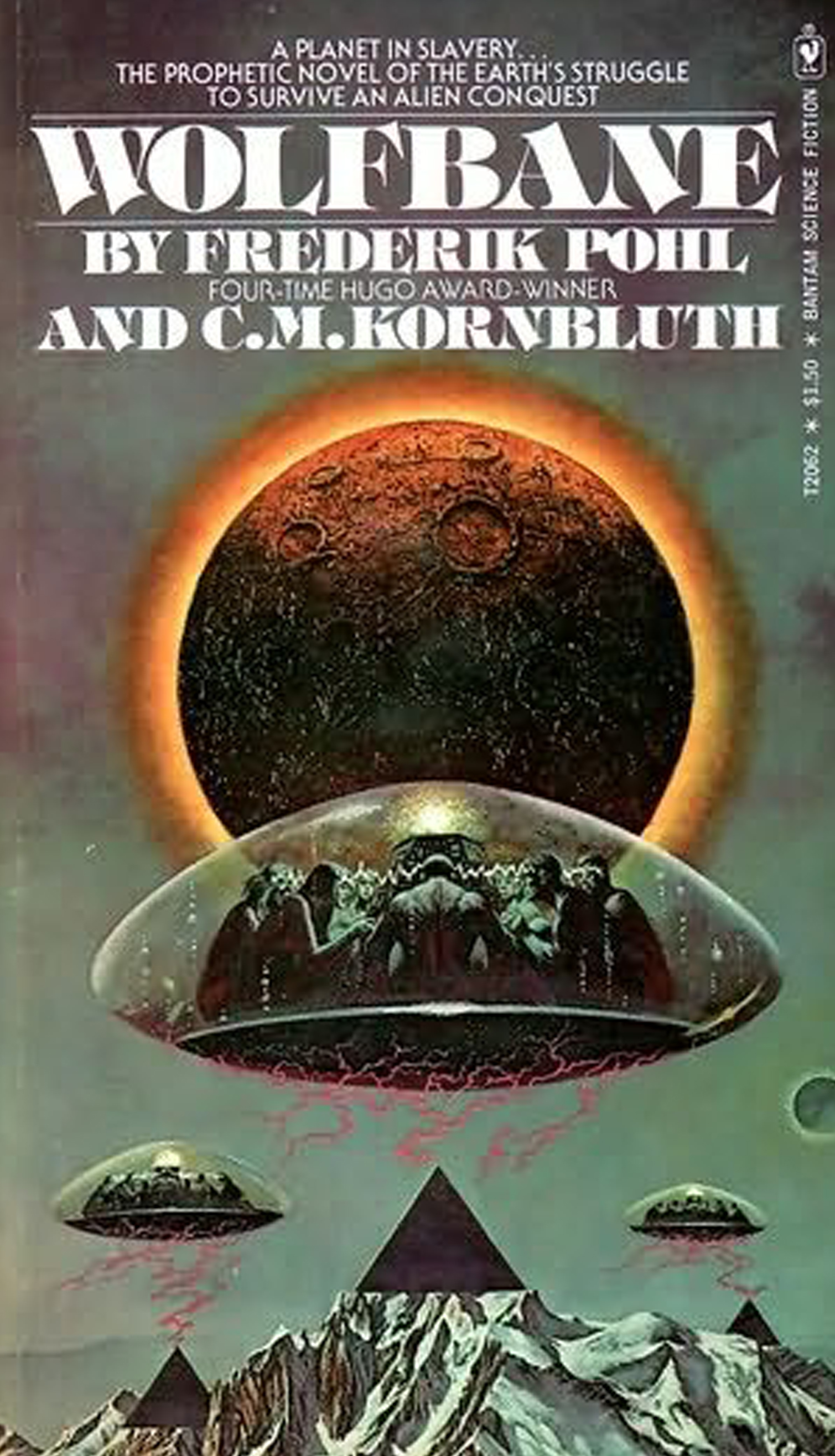
Wolfbane
by Frederik Pohl and C. M. Kornbluth
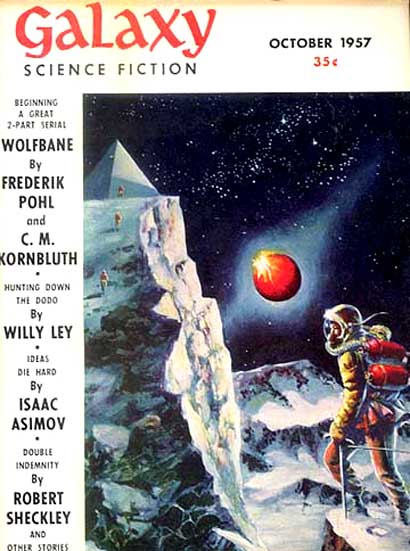
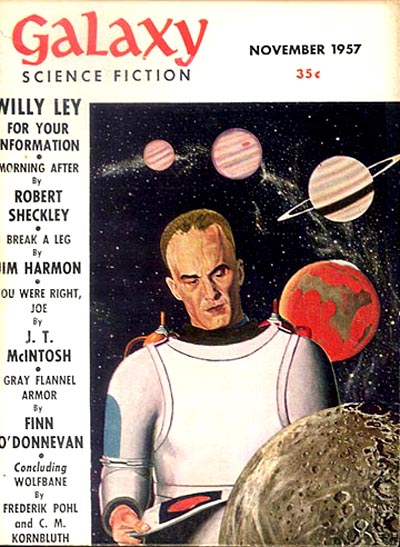
Original publication: October, 1957 and November, 1957 issues of Galaxy Science Fiction (as two-part magazine serial)
Ballantine Books, 1959 (simultaneous hardback and paperback, expanded version of Galaxy serial)
Most recent publication: Orion/Gollancz Science Fiction, 2000 (paperback); Wonder eBooks, 2008 (Kindle edition)

************************

Wolfbane was the fourth and final of Frederik Pohl’s and Cyril Kornbluth’s novel-length collaborations in science fiction. Due to the unique history of its composition – it was essentially written in phases, with three separate versions eventually seeing publication – it offers a particularly clear window into what Cyril Kornbluth added to the mix. Given that Frederik Pohl himself has admitted that he can’t remember with any degree of accuracy the extent of his contributions and Kornbluth’s contributions to their shared novels, at least in terms of sorting out who was responsible for introducing particular characters or plot elements, giving Wolfbane a close look promises to be an illuminating exercise.

Here is what Pohl had to say about the genesis of Wolfbane in his Introduction to the first collection of Pohl-Kornbluth short fiction, The Wonder Effect: “Wolfbane was a different sort of story. We planned it as a 15,000 word novelette—and wrote it that way, too, turn and about. But it was almost unreadable, far too telegraphic and compressed; and I opened it out to about 40,000 words, in which form it was published as a magazine serial; whereafter Cyril expanded it to about 60,000 words for the final book version. This was about the last writing Cyril did before his death.”

Wolfbane has been published in three versions: the two-part magazine serial published in the October and November, 1957 issues of Galaxy; the longer version (fifty percent longer than the magazine version) published in book form by Ballantine in 1959; and a third version, expanded and revised by Pohl for publication by Baen Books in 1986, during a period when Pohl was going back to each of his SF collaborations with Kornbluth and revising it.

Based upon the above information, it’s possible to read the 40,000 word Galaxy version and the 60,000 word 1959 Ballantine version back to back, determine which 20,000 words were added between the former and the latter, and ascribe those words to Cyril Kornbluth. And, being the obsessive fan that I am, that is what I did. In this way, Wolfbane can almost serve as a sort of Rosetta Stone for the Pohl-Kornbluth collaboration, putting to rest (if it still needs putting to rest) Kingsley Amis’s assertion from his 1960 work of criticism, New Maps of Hell, that all of the “good stuff,” the social and political extrapolation and satire, in the Pohl-Kornbluth collaboration came from Frederik Pohl, with Cyril Kornbluth only contributing the pulpier, more action-oriented material. (See my assessment of Amis’s assessment here.)

To the best of my knowledge, the initially published, 40,000 word version of Wolfbane has never been republished since it first appeared in 1957 in Galaxy. However, thanks to my friends at Books From the Crypt, an online store specializing in SF pulps and rare paperbacks, I was able to acquire the two issues of Galaxy at a reasonable price.

The entirety of the first portion of the serial from the October, 1957 issue was inserted pretty much unchanged and unexpanded into the 1959 book version, along with about the first quarter of the second installment, from the November, 1957 issue. The Galaxy version and the 1959 Ballantine Books version are indistinguishable to my eyes (apart from a few relatively minor revisions noted below) to the point in the story where Glenn Tropile, the book’s Wolf/Citizen protagonist, awakens on the binary planet which has stolen Earth from its orbit, embedded in a tank of nutrient liquid by the Pyramid aliens as one-eighth of a human computer. From that point forward, the two versions of Wolfbane differ considerably, although they share an identical ending (an ending which is granted much greater emotional power by Cyril Kornbluth’s additions to the second half of the 1959 Ballantine version).

Just a quick word on some peculiarities of the Galaxy version – the haste with which Pohl and Kornbluth wrote it and with which editor Horace L. Gold edited it are apparent. The two-part serial contains numerous typographical errors, as well as a pair of minor but nonetheless irritating story errors. The worst of these was having Gala Tropile, Glenn Tropile’s wife, translated/transported to a storage unit on the binary planet, then later appear in Citizen Roget Germyn’s house on Earth, prior to the warfare on the binary planet, won by the Earthmen, which allows the people abducted by the Pyramids to return to Earth. The lesser error was describing several activities of the Pyramids taking place on Earth’s moon, rather than on the binary planet where they must have taken place (every five years, the Pyramids ignite Earth’s moon into a small facsimile of the sun, in order to maintain livable conditions for the humans on Earth while Earth is being dragged through interstellar space by the binary planet’s propulsion system; so, apart from somehow lighting a series of fusion reactions on the moon’s surface, the Pyramids do not carry out any of their activities there). All of these errors were corrected for the 1959 book publication.

Wolfbane is “big picture” science fiction, futuristic adventure on a grand canvas. At the book’s start, seven eighths of the human race have died out, due to continual environmental catastrophes caused by the Earth’s removal from its orbit around the sun by alien invaders (only one of which actually resides on Earth, atop the shaved-off peak of Mount Everest, the rest of the Pyramids remaining on their binary planet, upon which they have installed propulsion machinery capable of moving that planet, Earth, and Earth’s moon through space as a mini-solar system). As mentioned above, every five years the Pyramids ignite the moon to serve as a miniature substitute for the sun, but the moon’s radiance quickly declines and eventually it burns out, necessitating another ignition. In the meantime, ice sheets have retreated and then advanced across Earth’s land surfaces, and the seas have expanded and then shrunk, causing havoc for humanity’s efforts at agriculture and forcing the shrunken, dispirited remnants of humanity to continually migrate, keeping abreast of the advancing and then retreating ice sheets. The purposes of the alien Pyramids are a complete mystery to humanity. No Pyramid ever attempts to communicate with any human. Pohl and Kornbluth do a brilliant job of portraying the type of society which might emerge from such conditions. In North America, society has reverted to bare subsistence farming and social norms very much akin to those of pre-modern Japan. Barely surviving on about five hundred calories of food intake per day, Citizens constrain their movements and indulge in arts requiring the most minute expenditures of energy, such as elaborate rituals of politeness, hospitality, eating, and meditation. Meditation is considered one of humanity’s highest pursuits. The culmination of the purest form of meditation is “translation,” or a visitation by a shimmering eye-like visage, followed by the sudden vanishing of the meditator. Any persons who display unusual initiative or selfishness or who try to utilize advanced technologies left over from the pre-Pyramid era are denounced as Sons of the Wolf, captured, and executed by draining their spinal fluid.

The novel’s protagonist, Glenn Tropile, is a Wolf who has been trying to act out the part of Citizen his entire life. However, during a crisis in his village, his mask slips, and he is caught pilfering extra rations of food. He is caught and sentenced to having his spinal fluid drained, but he manages to utilize both his intimate knowledge of Citizen social mores and his psychological hold over his wife to escape prison and execution. Once he is outside his village, he is picked up by a helicopter operated by members of a secret village of Wolves. These Wolves have been recreating the weaponry of pre-abduction Earth and carry out expeditions to Mount Everest at the beginning of each five-year moon-sun cycle to gather intelligence on the Pyramid sitting on the summit. Their ultimate goal is to wrest control of the Earth back from the alien Pyramids and to return Earth to its orbit around the sun. Tropile’s new comrades warn him not to practice meditation, as that activity is strongly associated with the appearance of shimmering eye visages and subsequent translation, or disappearance. However, one day while he is harvesting crops, Tropile takes a lunch break and ends up inadvertently falling into a meditative state while observing his pot of water boil over an open fire. An “eye” appears above him, and while some of the other Wolves watch, Tropile is translated and disappears. The Pyramid atop Mount Everest, noting that Tropile has cleared his mind of all thought, registers that he is ripe for harvesting and instantaneously transports him to a holding tank on the binary planet. There he is surgically “wired together” with seven other humans to form one of the Pyramids’ numerous biological computers, which they utilize to run all of the complex machinery on the binary planet, including the planet’s propulsion system and the feeding booths the Pyramids need in order to survive. The purpose for the Pyramids’ abduction of Earth was to secure a supply of components for their biological computers. Once that supply has been completely harvested and used up, the Pyramids will abandon their hold on Earth and locate another planet occupied by suitable life forms for them to harvest.

At this point in the story, the two versions diverge. Readers concerned about “spoilers” should skip to the last paragraph of this essay. I apologize, but it is virtually impossible to talk about two versions of the final third of a novel without giving away a good bit (if not all) of the climax. The earlier version comes to its climax when Tropile manages to awaken and organize his fellow seven nutrient tank dwellers, and they use their control over various mechanical and chemical processes on the binary planet to trick the Pyramids into transporting six hundred Wolves and Citizens from Earth who are known to Tropile to the binary planet, along with weapons from the Wolves’ village. There, rather than being placed into storage for use as computing elements for the Pyramids, Tropile and his allies set the Earth people loose in the tunnels beneath the binary planet to cause mayhem among its myriad of fragile mechanisms. They use the distraction they thus gain to seize control of the Pyramids’ instantaneous transportation mechanism and use it to hurl all of the thousands of Pyramids on the binary planet’s surface onto the burning surface of the moon, where they are destroyed.

Given the task of expanding the novel by 20,000 words for book publication, Cyril Kornbluth opted to change this sequence of events in a number of very interesting ways. In the earlier version, Pohl and Kornbluth gave a name and background to only one of the seven individuals Tropile finds himself sharing a nutrient tank with. Kornbluth opted in his expanded version to flesh out the identities of all of other seven “computing elements,” having them originate in various regions and continents of Earth still inhabited by humans and giving them widely disparate personalities and histories. In doing so, he offered a vivid portrait of a gestalt consciousness, on par with what Theodore Sturgeon had so memorably accomplished in his novel More Than Human (1953), which must have influenced Kornbluth. Kornbluth also portrays a much more fascinating picture of the interplay between this gestalt consciousness and the hundreds of human beings it causes to be transported from Earth to the binary planet. Rather than simply give them weapons and have them attack the Pyramids’ machines, the gestalt consciousness manipulates them, through alternating periods of satiety with periods of hunger and thirst, into becoming “mice” inside the tunnels and automated factories of the binary planet, causing continual destruction through their search for food and water. Kornbluth also included a scene wherein the separate personalities of the gestalt consciousness disaggregate themselves, and some, including Tropile, express horror at the callousness with which they have used their friends and relatives as tools, fomenting a brief but intense conflict among the eight partners and adding a new layer of psychological and moral complexity to the novel.

Another major change that Kornbluth made was to give the alien Pyramids a backstory. In the novel’s second version, rather than there being tens of thousands of Pyramids, there are only eight. The Pyramids were constructed thousands of years ago as mechanical servitors by a biological race which once inhabited the binary planet. The eight most powerful and invincible of these were designed to explore the stars. While they were carrying out their mission of interstellar exploration, the more mundane Pyramids turned on their creators, nearly wiping out the biological population before the creators managed to destroy their rebellious creations. However, when the eight super Pyramids returned and found that their brethren had been wiped out, they eradicated the remainder of their creators, leaving only one to hover between life and death, which they preserved in a sort of stasis in a chamber located on the binary planet’s north pole. Tropile’s gestalt consciousness manages to contact this one remaining Pyramid creator and convinces it to share its unique knowledge of the Pyramids’ weaknesses in order to defeat the eight super Pyramids.

In contrast to the cursory, summarized battle portrayed in the initial version of Wolfbane, the struggle portrayed in the 1959 version is a well thought-out military campaign against the Pyramids. Kornbluth utilized his knowledge of large-scale infantry combat and basic engineering, acquired during his Army service during World War Two, to write a vividly described, massive struggle between the gestalt consciousness and its human allies versus the Pyramids and their robots that spans the entirety of the binary planet. Tropile separates himself from his gestalt partners at great personal sacrifice to lead the human forces on a sabotage mission designed to destroy the Pyramids’ source of nutrients. The mission involves fierce combat against giant repair robots, combat which leaves a third of the human forces dead, but which succeeds in blowing up the central nutrient depository. The Pyramids are then doomed to run down and become inactive, having expended all their energy supplies in an ultimately successful though Pyrrhic attempt to destroy the gestalt.

Kornbluth and Pohl opted to retain their original ending from the Galaxy serial version. However, Kornbluth’s changes and additions to the story give that ending much more emotional heft, as well as more fully supporting and justifying Tropile’s decision to return to a form of gestalt consciousness, despite the deaths of his original seven partners.

The initial version of Wolfbane is an exciting and imaginative apocalyptic thriller that effectively evokes the SF sense of wonder. However, Cyril Kornbluth’s additional 20,000 words elevated it from a good SF novel to a classic SF novel.

Frederik Pohl has opined that, had Cyril Kornbluth lived a longer, more typical lifespan, he would have become one of the all-time greats of science fiction. Those final 20,000 words of Wolfbane were some of the last words that Kornbluth wrote, and they are some of his finest, most powerful, and most fully realized work. Had he continued producing long-form works of the quality of his work on Wolfbane, he would certainly now be at least as well-remembered and well-regarded as Isaac Asimov, Arthur C. Clarke, or Robert Heinlein. Bereft of this what-if, we are left only with his classic short fiction, a flawed but memorable solo novel (The Syndic), and his novel-length collaborations with Frederik Pohl as evidence of his skill and talent as a writer. Count his contribution to Wolfbane as one of the most compelling pieces of that evidence.

Heading Off to Richmond and RavenCon This Weekend

This Saturday and Sunday, I’ll be in Richmond, Virginia for my third year of RavenCon. Here are the specs:

RavenCon 2012
Holiday Inn Koger Center
1021 Koger Center Blvd,
North Chesterfield, VA 23235
(804) 379-3800
Weekend Rates
Adults (18 and up):
$35 by 03-30-12
$40 at the door
Young Adults
(12-17): $15
Children (11 and under):FREE
Day Rates
Friday: $15
Saturday: $25
Sunday: $15
*10% discount on rates with Military ID or Student/College ID

And here is my schedule:

Saturday, 4/14, 11:00 AM: Amazon vs. Independent Publishers Group (moderating), with Kate Palk, Lelia Taylor, Austin Comacho, Denise Comacho, and Jim Blanton

Saturday, 4/14, 12 noon: Signing in the dealers’ room

Sunday, 4/15, 10:00 AM: Writing for Tweens (moderating), with A. J. Hartley, Lelia Taylor, Davey Beauchamp, Pamela K. Kinney, and J. M. Lee

Sunday, 4/15, 12 noon: Steampunk as Alternate History, with Charles E. Gannon (moderating), Day Al-Mohamed, Michelle D. Sonnier, Scott M. Baker, and Lee Champion

Sunday, 4/15, 1:00 PM: Zombie vs. Robots, with Ahlen Moin (moderating), and Scott M. Baker

That panel on Amazon versus the Independent Publishers Group should be an interesting one. I’ll likely have one or two of my boys with me on Saturday; maybe Sunday, too. Hope to see many of my friends there!

Pohl + Kornbluth Part 6: the Collaborative Short Fiction

Return to Introduction
Return to The Space Merchants
Return to Search the Sky
Return to Two Solo Novels: The Syndic and Drunkard’s Walk
Return to Gladiator-at-Law

Although best known for their quartet of science fiction novels they published in collaboration, the partnership of Frederik Pohl and Cyril Kornbluth also produced about thirty-five short stories. These stories can be divided into three groups. The bulk of them (many now lost, or buried within one of the numerous pseudonyms the Futurians used during their early writing days) were written between 1939, when Cyril was 17 and Fred was 21, and 1943, when they both entered the U.S. Army. They produced an additional handful during the years between their collaborations on The Space Merchants in 1952 and Wolfbane in 1957. Following Kornbluth’s death on March 21, 1958, Pohl went through an assortment of manuscripts, both stories and a couple of unfinished novels, that his former writing partner had left incomplete, and over a period of about fifteen years expanded several of those fragments into complete stories. He also revised some of their earliest shared work together, pieces they had written in collaboration during the late 1930s or early 1940s and which had gotten temporarily lost.

Four collections of their collaborative short fiction have been published. The contents of each overlap a good bit, as you can see below (h/t: Wikipedia entry on Cyril Kornbluth):

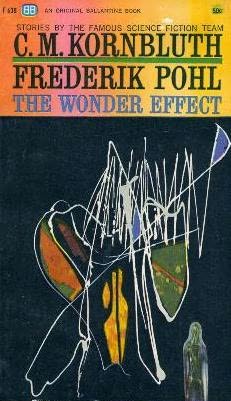
The Wonder Effect (1962)
“Introduction,”
“Critical Mass,” 1962
“A Gentle Dying,” 1961
“Nightmare with Zeppelins,” 1958
“Best Friend” [as by S. D. Gottesman], 1941
“The World of Myrion Flowers,” 1961
“Trouble in Time” [as by S. D. Gottesman], 1940
“The Engineer,” 1956
“Mars-Tube [as by S. D. Gottesman],” 1941
“The Quaker Cannon,” 1961

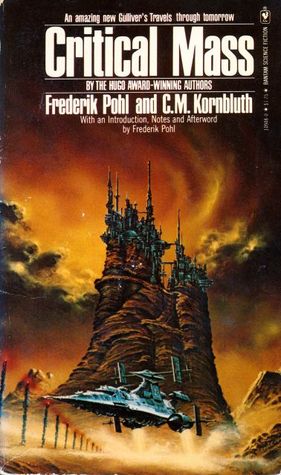
Critical Mass (1977)
“Introduction,” (Pohl)
“The Quaker Cannon,” 1961
“Mute Inglorious Tam,” 1974
“The World of Myrion Flowers,” 1961
“The Gift of Garigolli,” 1974
“A Gentle Dying,” 1961
“A Hint of Henbane,” 1961
“The Meeting,” 1972
“The Engineer,” 1956
“Nightmare with Zeppelins,” 1958
“Critical Mass,” 1962
“Afterword,” (Pohl)

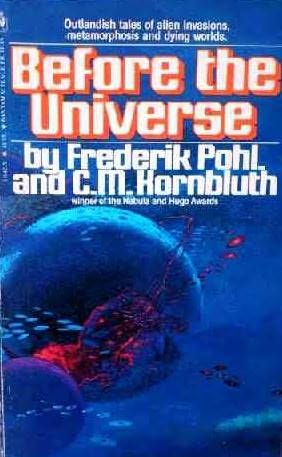
Before the Universe (1980)
“Introduction,” (Pohl)
“Mars-Tube” [as by S. D. Gottesman], 1941
“Trouble in Time” [as by S. D. Gottesman], 1940
“Vacant World” [as by Dirk Wylie (with Dirk Wylie and Pohl)], 1940
“Best Friend” [as by S. D. Gottesman], 1941
“Before the Universe” [as by S. D. Gottesman], 1939
“Nova Midplane” [as by S. D. Gottesman], 1940
“The Extrapolated Dimwit” [as by S. D. Gottesman], 1942
“Afterword,” (Pohl)

Our Best: The Best of Frederik Pohl and C.M. Kornbluth (1987)
“Introduction,” (Pohl)
“The Stories of the Sixties,” (Pohl, section introduction)
“Critical Mass,” 1962
“The World of Myrion Flowers,” 1961
“The Engineer,” 1956
“A Gentle Dying,” 1961
“Nightmare with Zeppelins,” 1958
“The Quaker Cannon,” 1961
“The 60/40 Stories,” (Pohl, section introduction)
“Trouble in Time” [as by S. D. Gottesman], 1940
“Mars-Tube” [as by S. D. Gottesman], 1941
“Epilogue to The Space Merchants,” (Pohl, section introduction)
“Gravy Planet,” (extract from the magazine serial, not used in the book)
“The Final Stories,” (Pohl, section introduction)
“Mute Inglorious Tam,” 1974
“The Gift of Garigolli,” 1974
“The Meeting,” 1972
“Afterword,” (Pohl)

In his Introduction to their collection of their early collaborative stories, Before the Universe, Pohl wrote, “The first published story by Cyril and me was ‘Before the Universe.’ … We worked out an assembly line procedure: I wrote an ‘action chart’ – essentially a plot outline, with some indication of characters and setting – from which Cyril wrote a first draft, which I then revised and retyped…” He also had this to say about their early collaborations (from his Introduction to their earliest collection of shared stories, The Wonder Effect): “A number of reviewers have speculated, and readers from time to time ask, what the mechanics of collaboration were between us. I take this to condone the vanity of supplying an answer. There isn’t one single answer, though, because we tried everything. At first I made up plots, Cyril fleshed out the stories and I rewrote them in final form for publication. That was the technique that produced the bulk of the early stories which I now hope to see forgotten. I was not a very good way of writing a story, and we never wrote a complete story that way after 1942.”

Their 1980 collection, Before the Universe, contains those early stories which Frederik Pohl is willing to share with the reading public. “Before the Universe,” “Nova Midplane,” and “The Extrapolated Dimwit” form a trilogy, the best that can be said of them being that they display a pulpish energy which sweeps the reader along and that the three main characters, two male scientists and a woman reporter, banter continuously in a not-too-bad imitation of Nick and Nora Charles from The Thin Man series of books and films, or the screwball comedies popular in the 1930s. I think the most enjoyable is the last, “The Extrapolated Dimwit,” wherein Pohl and Kornbluth shared the writing chores with fellow Futurian Robert “Doc” Lowndes. Of the remaining stories in the volume, “Best Friend” is interesting in that it focuses on evolved, intelligent dogs, a notion explored to great effect in the later stories of Cordwainer Smith. “Vacant World,” which was written in conjunction with Dirk Wylie, contains some memorable images of a seemingly abandoned Earth that wouldn’t be out of place in a Twilight Zone episode. “Mars-Tube” is probably the most technically proficient of these early stories, being an entertaining adventure story focusing on an ancient subway system beneath the surface of Mars.

Of the stories collected in the four volumes, the only one which Frederik Pohl identifies as having been completed after their military service and before Kornbluth’s death is “The Engineer,” which was a revised out-take, or unused scene, from their novel, Gladiator-at-Law, focusing on a character, a “political engineer” (in the same sense that Dwight Eisenhower was considered a “political general”) who does not appear in published versions of the novel. All of the other stories in The Wonder Effect, Critical Mass, and Our Best, with the exception of those stories these collections share with Before the Universe, were posthumous collaborations, where Pohl took up an incomplete story or fragment of a novel Kornbluth had left behind (or, in the case of “A Gentle Dying,” a pre-war collaborative story which had gotten misplaced) and expanded it into a full story, the last of which being “The Gift of Garigolli,” published sixteen years after Kornbluth’s death.

In his introduction to Critical Mass, Pohl wrote, “I think if Cyril had lived he would have become one of the all-time greats of the field. He was just hitting his stride when his health began to falter. … When the Army made him a machine-gunner, lugging a 50-calibre-heavy MG around the Ardennes forest, they shortened his life. Exertions damaged his heart, and in his midthirties his doctor told him that he had a clear choice. He could give up smoking, drinking, spices in his food, a lot of the food itself, irregular hours and excitement; or he could die of hypertension.”

Kornbluth followed his doctor’s advice for nearly a year, cutting virtually all his former pleasures out of his life and going on the primitive tranquilizers of the 1950s, which had the effect of making him sluggish and thick-headed and also making it impossible for him to write. Pohl continues: “So I suppose Cyril made his choice. In his place, I think I might have made the same one. He went back to coffee and cigarettes, gave up the medication, went back to writing, finished the revisions on Wolfbane, wrote two or three of his best novelettes, signed on as an editor for The Magazine of Fantasy and Science Fiction — his first experiment with editing, rather than writing, science fiction, and one which he enjoyed enormously. … And then on a snowy March morning I had a phone call from Mary, his wife, to say that Cyril had shoveled out their driveway to free his car, run to catch a train and dropped dead on the station platform.

“He left a bundle of incomplete manuscripts and fragments, some of which I was later able to revise and complete…”

One of the posthumous collaborations, “The Meeting,” was awarded a Hugo in 1973, the only Hugo Award Cyril Kornbluth would receive (he completed virtually all of his work before the Hugo Awards were established, although one of his best solo stories, “The Little Black Bag,” and one of his most memorable novellas, “The Marching Morons,” were selected by Robert Silverberg for The Science Fiction Hall of Fame, a trio of volumes assembled by the Science Fiction and Fantasy Writers of America to commemorate the finest short fiction to be published prior to 1965, too early to have been nominated for a Nebula Award). “The Meeting” is a very low-key story which centers on a subject very near Cyril Kornbluth’s heart — the plight of “exceptional children,” sufferers of autism or severe emotional-neurological impairments — that ends with a punch to the reader’s gut, subtle and powerful. Nearly as good is “Mute Inglorious Tam,” which isn’t a science fiction story at all, but rather a story about story-telling and the making of science fiction; it centers on a peasant in Medieval England who, had he lived in a less brutal and hand-to-mouth age, perhaps five centuries later, would have become a science fiction writer but who is trapped by the constraints of his time. I also really enjoyed “The Quaker Cannon,” which benefits from both writers’ years in the military, and “Nightmare with Zeppelins,” a proto-Steampunk story centering on the discovery of the secret of atomic power deep within the colonial Africa of the Victorian Age, a story which Frederik Pohl expanded from fragments of an unfinished novel about the Civil War’s Battle of the Crater which Kornbluth had been unable to complete. “Critical Mass” is noteworthy in that Pohl expanded it from three separate story fragments Kornbluth had left behind, plus an additional story fragment of Pohl’s own — four fragments in all.

In all honesty, I have to say that very few of the stories in these four collections approach the quality of the best of Cyril Kornbluth’s solo short fiction or the best of Frederik Pohl’s. Clearly, working at novel-length was a more appropriate venue within which their collaborative genius could shine. Also, the stories that have come down to us are either products of their earliest, youngest writing days or represent Frederik Pohl’s attempts, some more successful than others, at resurrecting the ashes of stories left undone. However, the lengths Pohl was willing to go over a fifteen year span to utilize virtually every usable scrap of prose Cyril Kornbluth left behind is a testimony to his enormous respect for the skills of his former partner and his desire that Cyril Kornbluth’s name should live on for readers of science fiction. As he wrote in the Afterword to Critical Mass, “Some person who is not me will have to decide how great a writer Cyril Kornbluth was. I was too close to him, as collaborator in many ways, and as friend.”

Next: Wolfbane

The Passover-Easter Discussion in a Jewish Geek Household

___________________________________________________________

One thing you can pretty much count on as a Jewish parent of young children in America is questions before Christmas along the lines of, “Can we put up lights for Christmas?” Similarly, before Easter you can expect to hear, “Can we decorate eggs for Easter?” Here’s how the discussion went this year.

*****************************************************

Asher (7 years old): Daddy, I want to decorate eggs for Easter. Can I?

Andy (47 years old): Uh, Asher, you know our holiday is Passover, right?

Asher: Sure, I know that! But can I decorate some eggs for Easter?

Andy: Actually, Easter isn’t about the Easter Bunny and decorating eggs. I mean, it is, a little, but it’s mainly a very important religious holiday for Christians.

Asher: Okay. But can I decorate some eggs for Easter?

Andy: I’ll think about it. Maybe one.

Levi (8 years old, interested in religion): Dad, what’s Easter all about?

Andy: Do you know who Jesus was? Christmas is a celebration of Jesus’s birthday. Easter is a celebration of, uh, his death and resurrection.

Levi: Resurrection? What’s that?

Andy: Umm, let’s step back just a little. Jesus was a Jewish man who lived about two thousand years ago in what is now Israel. He was a teacher, a kind of rabbi, and he was very gifted at it and become very popular. In fact, he became so popular that some of his followers thought he was the Messiah.

Levi: What’s a “messiah?”

Andy: In Jewish thinking, the Messiah is a descendant of King David who will bring all the Jews back to the Holy Land, reestablish the State of Israel, and usher in a time when all the peoples of the world will live in peace. Anyway, getting back to the Easter story, what happened to Jesus was the Romans, who controlled the Kingdom of Judea at the time, executed Jesus because they were afraid he would start a revolt among the Jews against their rule. The way they executed him was called crucifixion. They built a cross out of two big wooden planks, and they nailed him to the cross. They pounded spikes through his hands and his feet. Then they didn’t let him eat anything. He died from the nails and from hunger and thirst.

Asher: Did it hurt?

Andy: Yes.

Levi: What happened then?

Andy: Well, this is the part where we get to resurrection. Some of Jesus’s followers said they saw him rise from his grave two days after he was buried, and then he went up to Heaven to join God. Actually, according to Christians, he was a part of God, but that gets really complicated, and I don’t want to go into it now. “Resurrection” means coming back to life after you are dead. That’s what Easter celebrates.

Levi (eyes growing wide): So Jesus was a zombie?

Andy: Uhh, no…

Why Not a Real Munster for the Reboot of The Munsters?

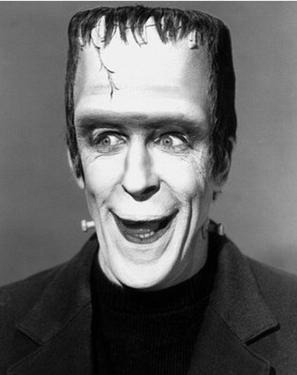
Word is beginning to leak out regarding who will portray the classic characters of the Munsters in NBC’s upcoming reboot of the 1960s comedy series, to be entitled Mockingbird Lane. (So what would have been so terrible about calling it The Munsters? At least NBC opted not to go the route Disney took with John Carter of Mars, which they shortened to just plain John Carter, not one of their better marketing moves of recent years; the Peacock Network, thankfully, did not choose to call their series The Mun.) Actor Eddie Izzard will apparently play the role of Grandpa Munster, and British actress Charity Wakefield is slated to portray the family’s “ugly duckling,” Marilyn Munster.

However, the big roles of Herman Munster and Lily Munster have yet to be cast. In the original series, Lily Munster was portrayed by the ravishingly beautiful Yvonne De Carlo, veteran actress of some of the biggest films of Hollywood’s Golden Age, including The Ten Commandments. So who should play Lily in the new version?


Why not a real Munster? Why not actress and plus-size model Tess Munster?

I mean, come on, why not? She’s already shown she’s got some acting chops. She’s got an appealing biography, having survived Hurricane Katrina in coastal Mississippi in 2005 and then gone on to a successful plus-size modeling career (overcoming the considerable skepticism of her family), later launching her acting career with the starring role in A&E’s real-life drama Heavy. Plus, she’s a blogger! What’s not to like?

But most important of all, can’t you just imagine the look on Herman Munster’s face should Tess become Lily? Hey, guys, wouldn’t you look like a love-smitten moose in Herman’s shoes, too?

Harmonic Convergence of Leisure-Time Pursuits

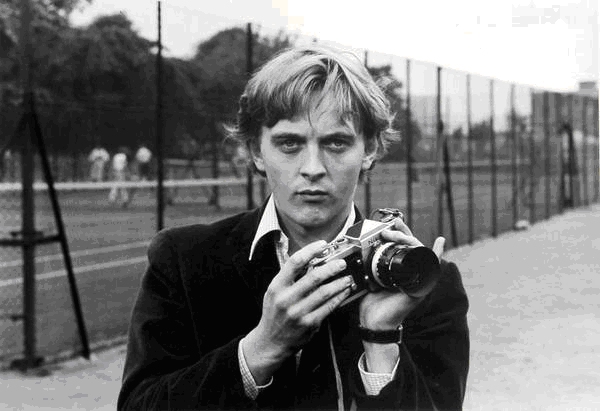
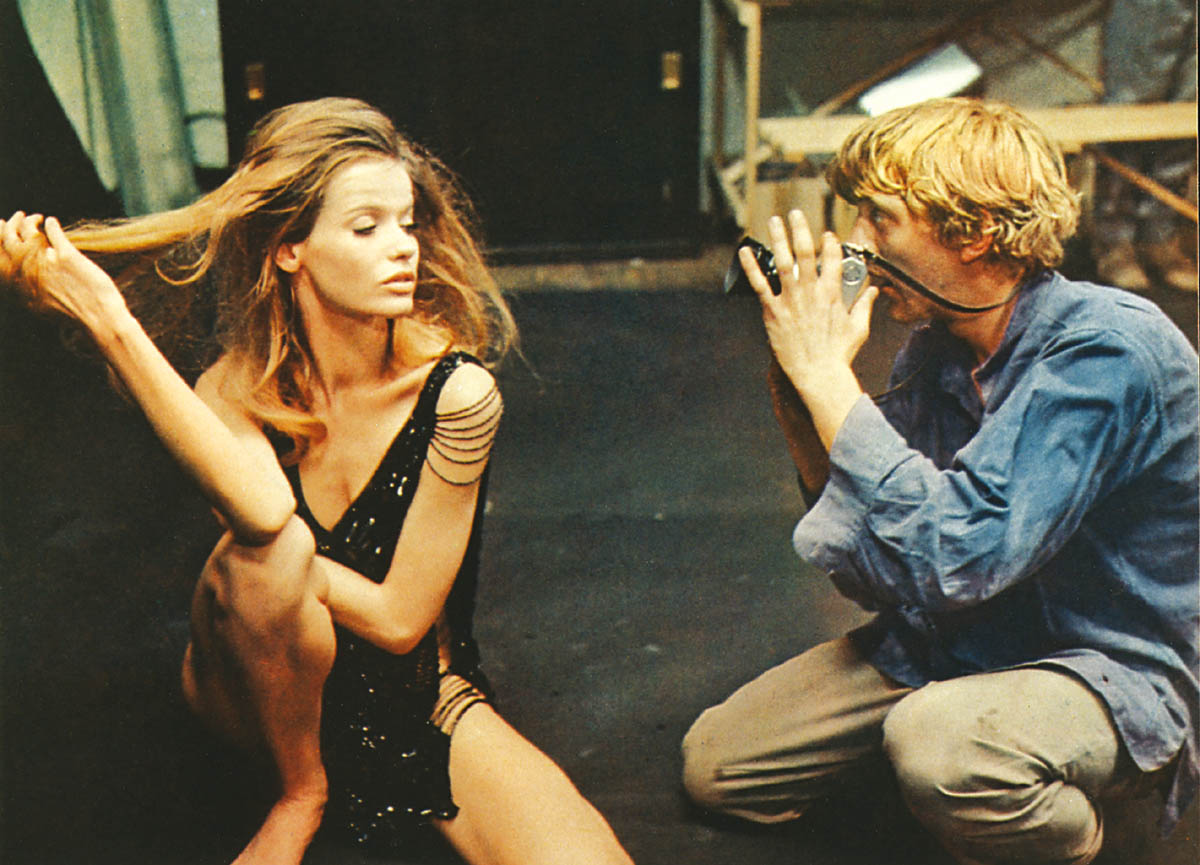
Seeing things from the point of view of a jaded photographer in BLOW-UP (1966)

Every now and then, one snaps to the realization that several of one’s pursuits or activities, due to no conscious design, fit together like the gears of a nice pocket watch. It happened to me this past weekend – a sort of “satori for geeks.”

Ever since this past summer, when I was finally able to divorce myself from my habit (of five year’s duration) of easing my three boys into sleep by lying down in bed with them (often falling asleep myself), and thus reclaimed some nightly reading time, I’ve been pursuing the project of reading much of the notable classic science fiction that I somehow missed out on during my personal Golden Age of Science Fiction (my teen years). Two of the writers whose vintage paperbacks have been falling into my acquisitive fingers with increasing frequency have been Philip Jose Farmer and Michael Moorcock. As a teen, I’m pretty sure all I read of Farmer was his collection Strange Relations, and my familiarity with Moorcock was limited to his novel-length version of Behold the Man (I wasn’t into sword and sorcery, so I avoided his then-omnipresent Elric books, and his Jerry Cornelius books weren’t widely available when I would’ve been apt to pick them up in the late 1970s or early 1980s).

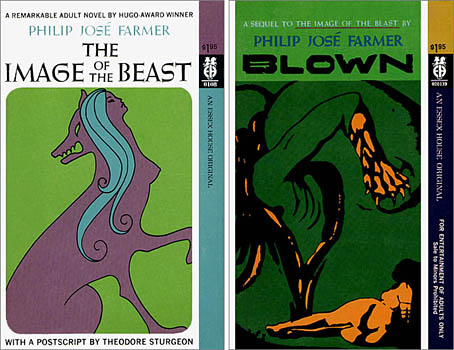
I’ve been collecting the “frisky Farmer” books, his early forays into exploring human-alien sex and the like. So far, I’ve found copies of The Lovers (the 1961 novelization of his 1953 short story), Dare, and Flesh, plus several of his Tarzan pastiches, which I’m sure have various forms of sex or sex-play in them. When it comes to old paperbacks, I prefer to find them in my local used bookstores or at conventions, but I think I may break down and utilize the Internets to get my hands on his two “pornographic” SF novels of the 1960s, Image of the Beast and Blown (which have been published by at least two publishers as a combined edition).

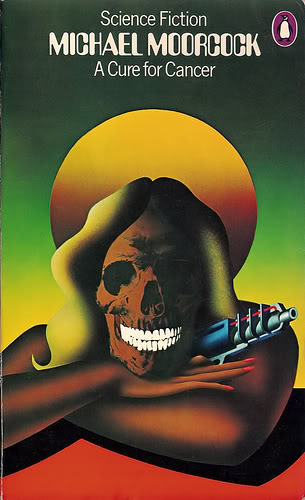
Michael Moorcock has also been popping up on my radar screen. I chanced into a nice vintage hardback copy of the second of his Jerry Cornelius novels from the late 1960s, A Cure for Cancer. I already had his collection of Jerry Cornelius short fiction, The Life and Times of Jerry Cornelius, sitting on my shelf waiting to be read, and, being a completest (and also having this blog to somehow fill each week), I have set off on a quest (also likely to be cut short by a visit to the Internets) for the other three Jerry Cornelius novels (which have been published both as stand-alones and as omnibus editions).

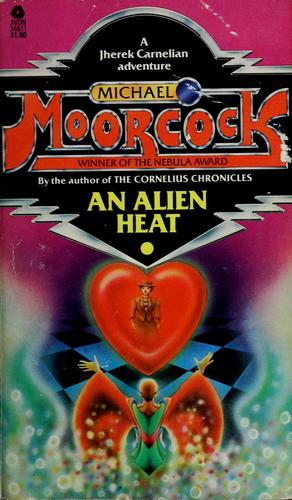
I also bought books two and four of his Jherek Carnelian/Dancers at the End of Time series, The Hollow Lands and The Transformation of Miss Mavis Ming, which means, of course, that my next order of business must be acquiring books one and three, An Alien Heat and The End of All Songs (which, like the Cornelius books, are available in several different handy omnibus editions). Jerry Cornelius and Jherek Carnelian are both avatars of Moorcock’s Eternal Champion, Cornelius being the 1960s embodiment (along with Elric, of course) and Carnelian being the 1970s embodiment (or one of them, Moorcock having been incredibly prolific throughout the 1960s and 1970s, sometimes writing books at a rate of 15,000 words per day, cranking them out in three or four days apiece!).

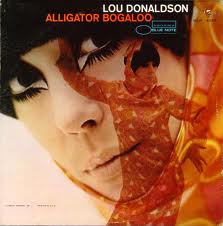
Accompanying my book-buying binges are occasional jazz CD buying binges. My most recent purchase was a meaty, satisfying compilation from Blue Note Records, Artist Selects: Lou Donaldson, in which the alto saxophonist picked out thirteen of his favorite tracks from his more than two decades of putting out albums on the Blue Note label. The earliest selections on the CD date from the early 1950s, when Lou sat in on a number of hard bop sessions with drummer/band leader Art Blakey and introduced pianist Horace Silver and trumpeter Clifford Brown to the Blue Note stable. Most of the second half of the cuts on the CD come from Lou’s “soul jazz” period, which began with his classic album Blues Walk in 1958. One of the keys to the Lou Donaldson quintet’s unique sound was the inclusion of conga drummer Ray Barretto, which made his numbers danceable, and which secured him placement in jukeboxes around the country. Not long after Blues Walk, Lou settled on a standard format for his soul jazz records, groups that included electric organ and guitar players (he liked having an organist accompany him because an electric organ was easy to transport, and many of the small clubs Lou’s groups played didn’t own a piano). This remained his preferred format throughout the 1960s. His most popular album of that time was Alligator Boogaloo, recorded in 1967, featuring Melvin Lastie on cornet, Lonnie Smith on organ, George Benson (before he became a singing star) on guitar, and the talented New Orleanian Leo Morris on drums. The title cut originated as a throwaway piece, an elaboration on a vamping groove that Lou conjured up at the last minute to fill four empty minutes on the record, but it ended up being the most commercially successful piece he ever recorded.

What brought these disparate works of pop culture together for me in flash of “geek satori?” It was watching Michelangelo Antonioni’s 1966 film Blow-Up on Turner Classic Movies. The Italian director’s first film in English (he made two more, Zabriskie Point and The Passenger, the latter starring Jack Nicholson), it was set in the Swinging London of the mid-1960s and featured a protagonist loosely based on a real-life British fashion photographer of the period. This movie, just like the only other Antonioni film I’ve seen, the earlier The Red Desert, is a visual feast, with stunning, unforgettable cinematography. It’s also a marvelous period piece, capturing the mod Swinging London of the Sixties like a fly trapped in shimmering celluloid amber. David Hemmings, who plays the unnamed photographer, lives in a sprawling photographer’s commune in an industrial part of London and drives an enormous Bentley convertible with blaise abandon, weaving it through streets meant for cars half its size. His days are filled with sexually provocative fashion shoots and the would-be groupies his notoriety attracts, and his evenings are filled with parties he experiences through a haze of drugs and alcohol. The City of London is rife with protesters against nuclear war and racism, as well as an “action squad” of mimes who drive about in an Army-surplus truck, looking for an audience.

The film’s plot (such as it is) hinges on a chance encounter between the photographer and two lovers in a neighborhood park. The photographer shoots a series of photos of the couple from long range, before being spotted by the woman (Vanessa Redgrave), who is considerably younger than her apparent paramour. She tracks the photographer back to his studio/commune and demands that he turn over his negatives. Intrigued by her reactions, he gives her a roll of film, but substitutes a different set of photos. Later, when he develops the photos of the couple, he sees, hidden in the bushes behind them, what might be a man with a gun and a dead body. He blows the images up in an attempt to figure out if what he thinks he sees was actually there. That evening, he returns to the park and finds the dead body. However, he has forgotten to bring his camera along. He goes to a party where he knows his agent will be present, intending to recruit him to return with him to the park to view the body. But he gets sidetracked by all of the drugs and sex available at the gathering. When he awakens the next morning and returns home, he discovers that, in his absence, all of the photos of the couple, plus his negatives, have been removed from his studio, which has been thoroughly ransacked. That evening, he spots the character portrayed by Vanessa Redgrave outside a theater. He follows her inside, only to get sidetracked once again by the wild scene inside, a raucous concert given by the Yardbirds. He loses her. The film ends the following morning, when he returns to the park and finds the body gone, no evidence left behind of it ever having been there. When he walks out of the park, the mime “action squad” spots him and their truck pulls over. The mimes spill out of the truck and rush to the park’s tennis court, where two of them mime a tennis match while the rest of them watch the “game.” The photographer watches, too. One of the mimes pretends to hit the “ball” over the fence, then signals for the photographer to fetch it. He pretends to toss it back to them. In the film’s final shot, he begins hearing the sounds of a tennis match from the mimed game.

My take on the film is that it was a subtle but telling broadside against the excesses of its age. The photographer is bored and filled with ennui due to the emptiness of his life and his fixation upon vapid surfaces. When something real and important — a possible murder — intrudes upon his existence, he is drawn to it, yet he is unable to extract himself from the morass of his over-stimulated milieu to do anything about it, either alert the authorities or solve the mystery of the killing himself. When we last see him, he is ascribing reality — the sounds of a ball being struck by a tennis racket — to phenomena which do not exist, to a mimed fantasy.

How do my other current leisure-time obsessions fit in with Blow-Up? Part of the film’s affect of alienation is achieved by the lack, for much of the film, of a musical soundtrack. The only times music is heard in the film is when one of the characters turns on a radio or a phonograph player or attends a concert. One of the only occasions on which David Hemmings’ character expresses any enthusiasm is when he plays a jazz record for the Vanessa Redgrave character. Although all of the movie’s instrumental music was composed by jazz pianist Herbie Hancock, this bit of jazz sounds exactly like Lou Donaldson’s quintet from Alligator Boogaloo. Soul jazz was very popular in the Swinging London of the mid-1960s, particularly electric organ groups. Herbie Hancock played on a number of Blue Note albums with Lou Donaldson, so he was very familiar with that sound. The photographer’s ultra-alpha male persona with women, his easy domination of his models and groupies, so easy that he becomes bored with the ease of it, reminded me very strongly of the protagonist of Philip Jose Farmer’s 1960 novel Flesh, an astronaut who returns to Earth after an absence of eight hundred years, only to be turned into the Sunhero, a living sex totem surgically enhanced with “the pure sex power of fifty bulls” (to quote from the back cover copy from a late 1960s reprint edition). But most of all, watching Blow-Up made me eager to dive into Michael Moorcock’s Jerry Cornelius novels and stories. Cornelius sprang from the exact same milieu that produced the photographer of Blow-Up. Moorcock and his good friend J. G. Ballard were an integral part of the Swinging London scene, one of the few times when the worlds of science fiction and the art world’s avant garde intersected (the only other time I can think of would be the Weimar Germany of the 1920s, when science fiction films like Fritz Lang’s Metropolis showcased German Expressionism).

What can I say about my having the experience of watching one of the key cinematic portraits of Swinging London enhanced by my serendipitous choices in reading and listening material?

Absolutely fab.