Archive for March 29, 2012

Carnival Time: Dreamland Amusements and Sellner Manufacturing

Anchors Away, the one-of-a-kind amusement ride from Sellner Manufacturing

This past Sunday, I took my three boys to a local carnival, set up in the big parking lot behind the Potomac Mills Mall in Woodbridge, Virginia. The carnival was running a “threatening weather special” on unlimited rides bracelets, and between the special and a set of $5 off coupons, I was able to buy each boy a bracelet for $15 apiece, which seemed reasonable (especially given that buying ride tickets would mean spending $3 or $4 per ride per child, which would very quickly eviscerate my wallet).

When I was a kid, I was a tremendous fan of carnival rides. I begged my parents to take me to any neighborhood or church carnival I heard about, and I’d squeeze in as many rides on the Zipper, the Octopus/Spider, the Tilt-A-Whirl, and the Rock-N-Roll as I could.

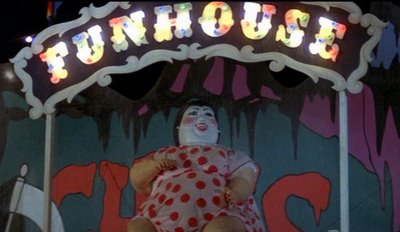
My longest continual carnival ride came in high school, when my theater club, the Pioneer Players, raised funds for our trip to the State Thespian Competition by hiring out all the members of our club as extras on the set of the low-budget horror film, The Funhouse, directed by Tobe Hooper and filmed in North Miami in 1981. Nearly all of the film takes place on a carnival midway, and the filmmakers needed hundreds of extras to ride the rides and play games and walk around eating corndogs and fried dough. (The filming took place on the grounds of the old Ivan Tors Studio on 125th Street in North Miami, where Flipper and other TV shows had been produced.) My job turned out to be riding the Sizzler, which twists and twirls you around and around and around. Turned out I had to ride the Sizzler for more than five hours straight, from about 9 PM to 2 AM. On a very chilly night (for North Miami, that is… it was probably in the 50s). Good thing I had a strong stomach back then. I doubt I could handle the Sizzler for five minutes straight at my age now, much less for five hours. The producers called things to a halt a little before 2 AM and invited all us extras into a chow tent for some hot chocolate and hamburgers. By that time I was very hungry and VERY cold (not to mention very tired), so I appreciated their largess.

Anyway, my kids are about as nuts for carnival rides as I once was. So I felt really good about being able to buy them unlimited rides bracelets, which meant I wouldn’t have to carefully ration their rides, like I had during every other trip to a carnival we’ve made as a family. My surprise of the afternoon was how good I ended up feeling about the workers on the midway. There is a widespread stereotype of carnival workers (“carnies”) being, well, skeevy, greasy, ill-mannered, and generally unpleasant. I won’t say that I’ve never had the displeasure of interacting with carnival workers who lived down to the stereotype. However, that didn’t occur at this carnival, operated by Dreamland Amusements. The workers I had the pleasure to interact with were friendly, helpful, and attentive to my anxiety that my kids should be properly strapped and buckled into rides (I almost had a panic attack when I saw that Judah, my five-year-old, had wrapped the bumper car seat belt around his neck after climbing in next to his older brother Levi, but the operator assured me he would sort Judah out, and he did).

One employee was especially friendly, talkative, and helpful. He operated a ride called Anchors Away, a pair of pirate ships that swung on half-moon-shaped tracks, giving the riders a cascading back-and-forth swinging ride (there’s a photo of the ride at the top of this post). All three boys initially rode Anchors Away together. The operator, a man in his sixties, surprised me by showing genuine enthusiasm for children, a quality I don’t typically see in this sort of setting – he laughed with them and encouraged them to raise their arms into the air while the ride swung them back and forth. At first, I wasn’t sure that Judah was enjoying himself. He had a very disconcerted expression the first couple of swings. But then he raised his arms like his brothers were doing, and by the end of the ride he was smiling and laughing. They all asked to ride it again, and since they had ride bracelets, I said, “Sure! Why not?” But when his two older brothers said they wanted to go next door to ride the Sky Hawk, a ride too advanced for Judah, Judah said he wanted to stay and ride Anchors Away some more.

He ended up riding it eight times in a row, and he would’ve kept right on riding it if I had let him. Once, when there were no other children or adults in line with him, the operator even let him ride it all by himself. The operator told me that recently, at a State Fair in Tampa, Florida, a mother had let her little girl, about Judah’s age, ride Anchors Away all day long. I noticed a sign hanging from the guard railing surrounding the ride. It gave a brief history of this particular Anchors Away ride, one-of-a-kind. The ride had been designed by Bruce Sellner, president of Sellner Manufacturing of Faribault, Minnesota, in the mid-1990s. Mr. Sellner had intended for Anchors Away to become a new mainstay of Sellner Manufacturing. However, he passed away shortly after designing the ride and seeing the first one built, and the company decided that it would build and sell only that initial unit. (Did they do this as a memorial for Bruce Sellner? It seems like a better memorial would’ve been to keep building more units of the last ride design he had championed. But maybe his family members who took over the business after his death decided the business model for making more of them no longer stood.) The one and only Anchors Away was sold to a West Coast carnival company, which owned it until last year, when Dreamland Amusements bought it. The sign announced that Dreamland Amusements was proud to bring the only Anchors Away to carnival-goers on the East Coast for the first time.

I wish more carnivals would do this sort of thing – publicize what is unique about their rides and attractions. I’m sure individual rides must take on lives and histories of their own, considering that many of them travel around the country for decades. The rides at Dreamland Amusements range in age from at least my age (I was born in 1964) to less than a year old (they purchased their one-truck Himalaya ride, manufactured by Wisdom Rides, in 2011, and their Dizzy Dragons kiddy ride is also pretty new). The oldest ride I saw probably dates to the mid-1960s; it was a kiddy automobile racing ride, with miniature cars mounted on a turntable. I can pretty much date it to around 1965 or 1966 because all of the cars were either first generation Ford Mustangs (first built in 1964) or early 1960s Corvette Mako Shark concept cars (the concept car precursors to the second generation Stingray Corvettes that came out in 1968). That modest little ride has seen quite a lot of use; how many thousands of kids have sat inside those miniature Mustangs and Corvettes and twirled their steering wheels over the past forty-five years? It is a little staggering to think how many times the ride has been put together and taken apart during its career, considering that it gets disassembled at the end of each show, mounted in pieces on a truck, then reassembled at the next show a week or two later. I’ll bet the long-time carnival workers get pretty attached to and sentimental about the rides they work with, considering that they take them apart and put them together probably between twenty and thirty times each year, then spend long hours operating them in-between.

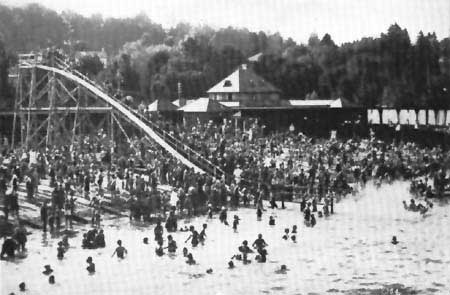
The Water Toboggan, Sellner Manufacturing's first amusement ride

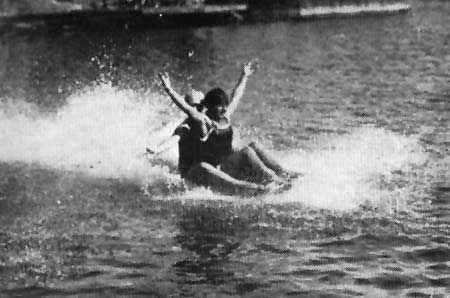
A happy landing on Sellner's Water Tobaggan

The day after taking the kids to the carnival, I looked up the history of Sellner Manufacturing, the makers of the one and only Anchors Away. The company got started way back in 1923 by Herbert W. Sellner (grandfather of Bruce Sellner, who invented Anchors Away). The first ride Herbert manufactured was the Water-Toboggan Slide, designed for swimming parks on lakes. Boy, does that look like it was fun! Check out these photos. Can you imagine riding a toboggan down that long, tall, steep slide, then skimming a hundred feet across the surface of a lake? What a thrill that must’ve been!

But Sellner Manufacturing’s biggest success and greatest claim to fame rolled out a few years later, in 1926, when Herbert Sellmer invented the Tilt-A-Whirl. They manufactured hundreds of the original design, and they continue to build updated models today (Sellner Manufacturing, a family-owned company for most of its existence, was purchased by Larson International in 2011).

Sellner's Tilt-A-Whirl ride in the 1940s

Take a look at this photo of a Tilt-A-Whirl from the 1940s. I’ll bet lots of readers my age or even a little younger will recognize the design. I rode Tilt-A-Whirls exactly like the one in the photo throughout the 1970s, and I’ll bet if I were to rent a copy of The Funhouse from Netflicks, I’d see one of the old-style Tilt-A-Whirls spinning on that haunted midway where I rode a Sizzler for five hours straight.

Just for comparison’s sake, here’s a photo of a modern-day Tilt-A-Whirl, a custom designed Mardi Gras version Sellner Manufacturing built for New Orleans’ City Park Story Land after Hurricane Katrina destroyed all of the park’s original amusement rides.

Pohl + Kornbluth Part 5: Gladiator-at-Law

Return to Introduction
Return to The Space Merchants
Return to Search the Sky
Return to Two Solo Novels: The Syndic and Drunkard’s Walk

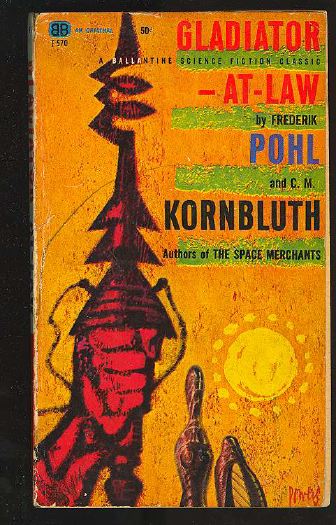
Gladiator-at-Law
by Frederik Pohl and C. M. Kornbluth
Original publication: as a three-part serial in Galaxy Science Fiction, June-August, 1954; Ballantine Books, 1955 (hardback/paperback)
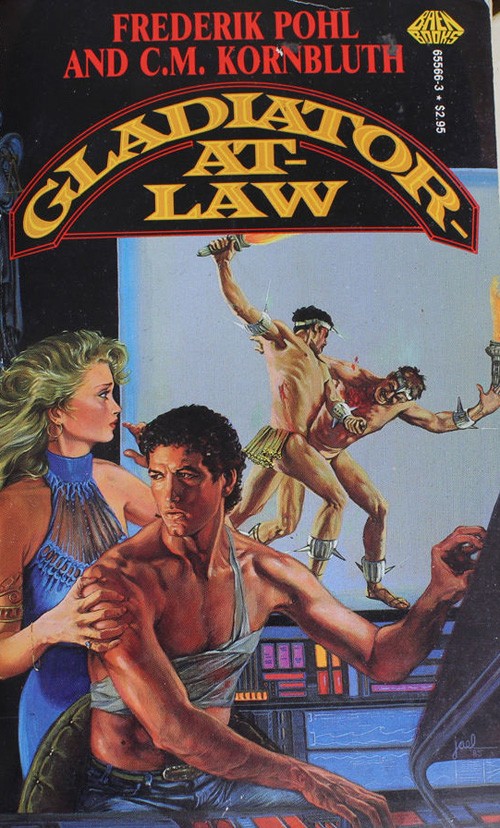
Most recent publication: Baen Books, 1986 (paperback, revised by Frederik Pohl from 1955 edition)

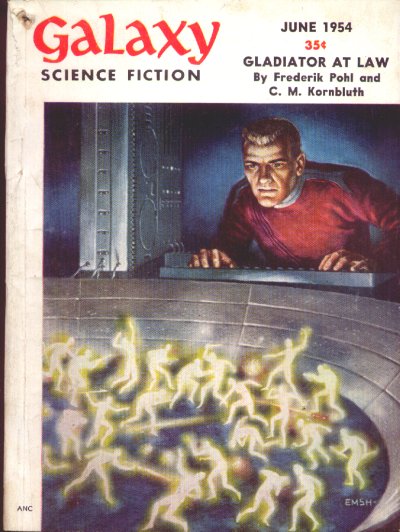
Of the four Frederik Pohl-Cyril Kornbluth novel-length collaborations, I think their third, Gladiator-at-Law, is my favorite. Not because it offered the most relevant social satire – that would be The Space Merchants — nor because it was the most imaginatively audacious – that would be Wolfbane. However, I found it to be the most entertaining of the four books. In large part I was thoroughly entertained because of the novel’s large cast of well-drawn, sympathetic, and ultimately endearing characters.

This isn’t to say that Gladiator-at-Law is without its satisfactions as social satire or regarding the science fictional ideas it presents. It is fairly rich in both, even if it doesn’t quite match up to The Space Merchants when it comes to social satire or to Wolfbane when it comes to bat-sh%t-crazy sense-of-wonder concepts. One of the central notions presented in Gladiator-at-Law is that corporate law firms have become the most powerful elements in a future American society (as opposed to The Space Merchants’ advertising firms). The rationale for the rise and supremacy of corporate law firms is not offered with nearly the same level of exposition as the rise of advertising firms was in the earlier novel. However, a rather compelling rationale is offered regarding how major corporations maintain a chokehold on their most valued employees. They entrap employees with the honeypots of subsidized housing. And not just any subsidized housing, but what is referred to as “bubble housing,” or G.M.L. Homes (short for Gorman-Mofatt-Lavin Homes, Gorman and Lavin having been the inventors of the “machines for living in” and Mofatt the vital money man).

What is it that makes a G.M.L. Home so desirable – so desirable, in fact, that any neighborhoods or subdivisions made up of non-bubble housing are considered substandard and quickly devolve into slums for the poor and working classes? G.M.L. Homes are completely and instantly configurable by their residents. Locations of walls, doors, windows, furniture, and appliances may be changed at the press of a button or the twirl of a dial. Colors of wall paper or pieces of artwork can be switched on a whim. The home is self-cleaning and self-maintaining. It cooks meals automatically, massages its residents to sleep, wakes them at the proper time in the morning, and assists them with personal hygiene and dressing, so efficiently that the typical businessman can go from asleep in bed to walking out the door in less than ninety seconds. The residents of G.M.L. homes quickly become dependent upon the conveniences and luxuries that a bubble house can provide. Which is very much to the benefit of the companies which employ those residents, for bubble houses are too expensive for individual citizens to purchase and must be provided by corporations, which lease them and then make them part of their employees’ compensation packages. Thus, for nearly all white-collar and professional employees, losing their job also means losing their bubble house, which means being thrust into one of the slums made up of traditional, non-bubble housing. Fear of this outcome is sufficient to keep most employees tethered to their employers for life.

What fascinates me most about Gladiator-at-Law is the way that Pohl and Kornbluth were able to foresee the evolution of many of the cookie-cutter suburbs which were constructed for returning GI’s and their families after the Second World War, when the GI Bill opened up the possibilities of home ownership and a college education to veterans. Some of those early suburbs, such as the original Levittown on Long Island, have been able to maintain their desirability as middle-class places of residence, due to their physical proximity to healthy, jobs-rich urban cores and to sufficient public transportation and highways. Many others, however, what are now commonly called “inner ring suburbs,” have been abandoned by the middle and professional classes, who have moved to more modern and spacious housing farther away from the central cities. The newer residents of these inner ring suburbs are recent immigrants or poor or working class residents who have moved out of the city centers (often when those city centers have become gentrified and re-occupied by the same sorts of white-collar and professional residents who fled them after the Second World War). One of the novel’s primary settings, the slum called Belly Rave, was built as a GI Bill suburb shortly after WWII and was originally called Belle Reve. In lots of the metropolitan areas of the Northeast and Midwest, the actual post-WWII Belle Reves have devolved into suburban slums not very much different from the portrayal of Belly Rave in Gladiator-at-Law.

The other significant social extrapolation made by Pohl and Kornbluth in this novel is the rise of ultra-violent entertainments for the suburban masses, provided in a “bread and circuses” format in coliseum-like stadiums. The combatants are either drunken thrill-seekers or impoverished wretches who see no other possible future than to commit themselves to a likely death or maiming in the chance of earning some money. With a few tweaks, what the authors suggested back in 1954 can be seen as a prediction of some of what makes up our current smorgasbord of reality television, shows such as Survivor, Fear Factor, Wipeout, I Survived a Japanese Game Show, and Dog Eat Dog, which place (supposedly) non-actors and non-stunt people in potentially hazardous situations and environments. The format has been extended to the ranks of the moderately or formerly famous with Celebrity Circus, in which viewers get to watch people they might actually recognize risk their necks. Whether one views the explosion of reality TV as a welcome widening of America’s entertainment options or as a prime example of the coarsening and decline of popular entertainment, it is interesting to note that the phenomenon was not instigated by a coordinated plan among programming executives at the major networks, but rather by an economic event – the November, 2007 to February, 2008 strike of the Writers Guild of America, which shut down the production of what had been the heart of network TV’s evening schedules – scripted comedies and dramas. Reality TV shows, primarily adapted from British models at first, were rushed into production to plug holes in network schedules. When they proved to be both popular and relatively cheap (compared to scripted comedies and dramas), the major networks and many cable channels shifted a significant amount of programming hours towards what had originally been thought to be a stop-gap measure. And Cyril Kornbluth looks down from SF writers’ heaven and enjoys a wry chuckle at our expense.

Another factor which greatly adds to the appeal of Gladiator-at-Law (and which helps keep this nearly sixty-year-old genre novel fresh for new audiences) is the high quality of its characterizations. Virtually all of the primary characters begin their story arcs as losers of some kind – some as lovable losers, others as rather contemptible losers. By the end of the novel, each of these characters has been challenged to rise above his or her former station and to perform daring acts they would not have dreamed of accomplishing at the book’s beginning. Charles Mundin starts the book as a criminal lawyer barely scraping by on other lawyers’ leavings and charity cases thrown to him by his low-level connections in the local political ward hierarchy. Donald and Norma Lavin, the rightful heirs to the G.M.L. Homes fortune, are locked out of their inheritance by the machinations of G.M.L. and the shadowy, powerful corporate law firm of Green, Charlesworth, and Donald has been reduced to a brainwashed semi-moron to keep him from remembering the location of his stock certificates. Norvell Bligh is a fearful, easily intimidated designer of blood-sport spectacles for a third-rate production company, responsible for upcoming Field Day shows, barely hanging onto his job and the bubble house that comes with it. His shrewish wife, Virginia, and her lazy, disrespectful daughter, Alexandra, both of whom have climbed out of their origins in the slum of Belly Rave, only make Norvell’s existence more hellish. Yet by the end of the novel, each of these characters has been transformed, mostly of their own volition and due to their own initiative. Together, they form an extended family and team capable of facing down the mighty firm of Green, Charlesworth and restoring some of the original promise of Gorman’s and Lavin’s invention to improve the lives of common working people, rather than enslave them.

Pohl’s and Kornbluth’s story, while a critique of predatory capitalism, does not condemn capitalism as an economic system. Rather, it suggests that, as an economic system, it is only as humane and civic-minded as the people who participate in it. The novel suggests that people such as its protagonists, who have both suffered from the worst excesses of capitalism and who have experienced their ability to better themselves through utilizing capitalism’s tools, may be the types of “captains of industry” capitalism needs to fulfill its potential as an enabler of human progress and happiness.

Next: the collaborative short fiction

Seduction of the Innocent, Indeed…

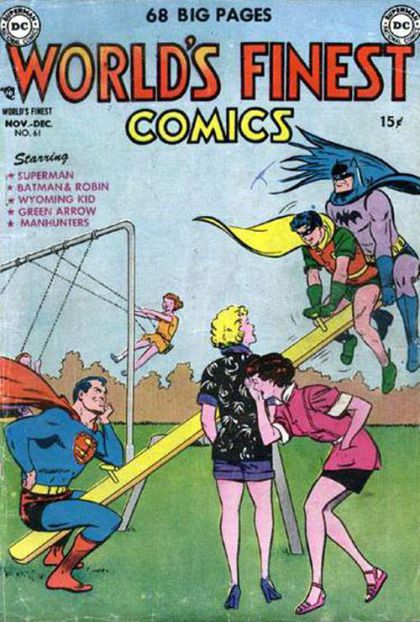
Here’s a Batman and Robin cover image you can be sure kept Dr. Fredric Wertham up late at night… and, gee, what could Lois possibly be whispering to Superman about?

(h/t: James Lileks)

Virgin-Eyed in San Francisco

Music-themed mural in North Beach

As I mentioned in my first blog post on visiting San Francisco, I think one of the greatest pleasures the modern world offers is the opportunity to visit a great city for the first time and to see it with virgin eyes. If one has the chance to wander somewhat aimlessly and drink in the sights of a new city at one’s leisure, one should grab that chance.

I didn’t have a tremendous amount of leisure time during my business trip to San Francisco, but I did my best to make the most of the time I had. After my Tuesday at the office supporting computer training, I headed back to my hotel, changed my clothes, rested a short while, and then headed through Chinatown on my way to hop aboard a Hyde Street cable car.

Very spooky cocktail lounge; would fit right into Mount MonstraCity

I loved Chinatown. I loved the ticky-tacky street vistas of Chinatown, with the chains of red lanterns strung from storefront to storefront across the narrow roadways. I loved seeing neon signs in both Mandarin Chinese and English. I loved this creepy cocktail lounge, made to look like the entrance to a cave… a dragon’s lair. Oddly enough, I was in the middle of reading a collection of Agents of Atlas comics, which is partially set in a subterranean city hidden half a mile beneath San Francisco, guarded by a dragon, and the surface entrance to the city is accessed through… a creepy cocktail lounge in Chinatown.

Mural on front of Chinatown Head Start, thanking the children for being helpful to their elders at a senior citizens' center

I stopped to look at the cut-out photos of children adorning a mural on the front wall of a Chinatown Head Start center. An inscription near the bottom of the mural thanked the center’s children for being especially helpful to their elders at a nearby senior citizen’s center. I liked that; it wasn’t something I was likely to run into back in Manassas. Half a block away, elderly men and women practiced their tai chi in the early morning in a park I could view from the nineteenth floor of my hotel, a park where children, maybe those same children from the Head Start center, played on slides and climbing bars. It was refreshing to see such disparate generations freely intermingling. A porter at my hotel told me the elderly are out there in the park doing their tai chi every single morning, no matter the weather.

I just love this guy for some reason

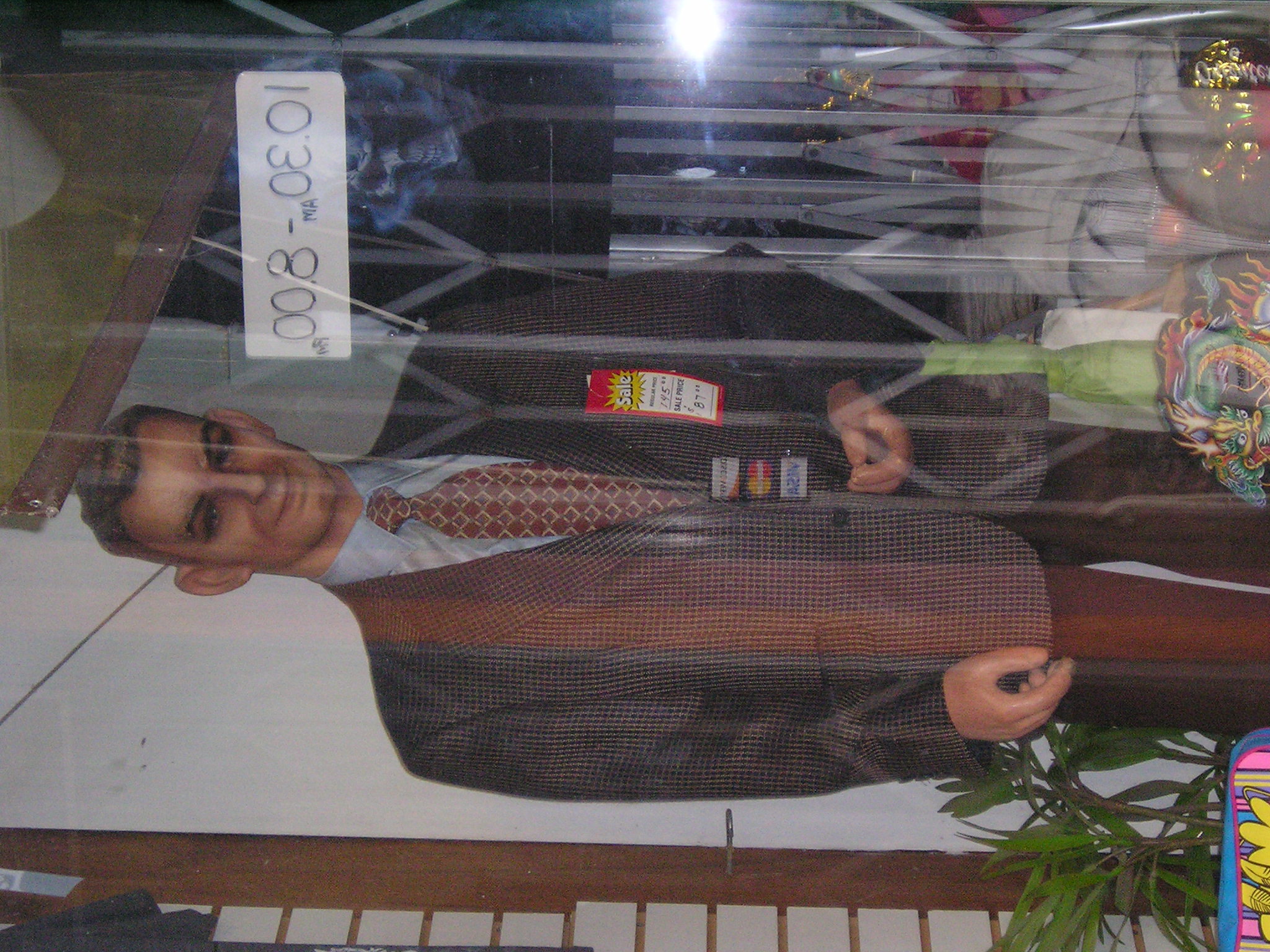
Shopping was fun. One store I wandered into was a typical teeshirts-and-souvenirs joint in the front and a men’s clothing store in the back. The men’s clothing portion was only open on Wednesdays. I made a note to come back the following day, Wednesday, so I could shop for a sport coat. For sitting in the display window was a mannequin straight out of the Lincoln Road of my Miami Beach youth, mid-1960s vintage, wearing a checkered sport coat I would kill for. Plus, the mannequin had a rather endearing look on his face – a look of mischievous embarrassment, as though he’d just farted on an elevator. Oh, how I wanted his coat! Which was on sale! For $78.95! But, alas, when I returned to the shop the next day to speak with the proprietor, I discovered that he only stocked jackets and suits in short sizes. I wear a regular, so I was out of luck.

A Hyde Street cable car waited for me at the edge of Chinatown. Some sort of accident a block north had kept the cable car and two behind it sitting immobile for fifteen minutes or so. The car I boarded was crowded with a group of tourists from France. One of the French women was quite incensed that the cable car would not move. She berated the operator and demanded that she and her entire party receive a refund of their fares (six bucks a head, not an inconsiderable sum), saying they would be late for their dinner engagement. One does not board a cable car, I believe, if one is in a hurry; one flags down a cab. The operator said he could not refund her money, at which point she continued to berate him, at which point he exited the cable car to go talk with the operator of the car stalled to our rear.

Street scene in Chinatown

After I had sat on the cable car for about ten minutes (not in any hurry to get anywhere myself, enjoying being able to absorb the details of the surrounding neighborhood), the accident ahead was cleared, and the cable car began to move. What a shambling, clanking, vibrating, crashing, wonderful mechanical monstrosity! By way of comparison, the electric streetcars I remember riding in New Orleans were paragons of smoothness and quiet. This beast, however, had the feel of an old-time roller coaster, a carnival ride of World War One vintage, albeit a roller coaster that operated in slow motion. I couldn’t hear the conversations of the French tourists, even though they were sitting only feet away from me. All I could hear was CLANK-CLANK-CLANK-CLANK-CLANK! During part of my ride, I sat next to the brake man, who operated three levers as long as his torso. His job was a physically exhausting one – he could hardly have worked harder had his task required him to jump out in front of the cable car on steep descents and lean his back against its prow with his heels dug into the pavement in order to slow it down. The way he leaned back with all his weight tugging on the levers, his gloved hands gripping the wooden handles so tightly that the veins on the backs of his hands must have bulged like blue wires, reminded me of the scenes of manual laborers continually adjusting the hands of gigantic clocks in the underground factory of Fritz Lang’s Metropolis. On the steepest part of the route, the part where we passed by Coit Tower, all the houses to my right and left looked weirdly askew, tilted at angles twenty or thirty degrees out of true, like buildings and rooms inside a fun house. This wasn’t public transportation – this was a thrill ride, one that just happened to wind through other people’s very pricey neighborhoods. I could just hear my boys shouting (had I brought them along), “Again! Again! Let’s ride it AGAIN!”

I’d told myself I would ride to the end, get off, walk around whichever neighborhood the car let me off in, then get back on and ride back to the Financial District. My ride ended at the edge of the Fisherman’s Wharf area. The weather was whip-windy and cool, on the verge of cold. I hadn’t dressed especially warmly, wearing a light sweater and a sport coat, but I figured I’d stay adequately warm if I walked briskly enough. The lateness of the hour on a Tuesday evening and the biting wind combined to keep most pedestrians inside, in one of the seafood restaurants or hotels that lined the waterfront. One of the only persons I passed on the sidewalk was a man who had dressed his three dogs like clowns and asked me to pay him to have my photo taken with them. (I didn’t oblige him.)

Then I heard an odd sound echoing down the empty waterfront street. A kind of barking – but not that of dogs – and honking – but not that of car horns. I followed the noise, remembering that I’d read somewhere that a colony of sea lions had taken up residence somewhere on the San Francisco waterfront. Sure enough, when I came to the end of a deserted wharf, I found them, even though they blended completely into the darkness (the moon was almost full, so I was able to just barely see the silhouettes of the sea lions when they slid over one another and scootched themselves about). The clamor they were capable of making was terrific — imagine a “free jazz” concert of dozens and dozens of tenor and bass saxophones, French horns, tubas, and trombones, mixed in with raucous belches, bleetings, honkings, snarls, sneezes, bleatings, and lots and lots of panting and slapping of wet flippers against wet hides. Knowing my wife Dara was a big-time animal-lover, even though it was midnight back in Virginia, I called her up on my cell phone. “Sorry to wake you, hon, but I knew you’d want to hear this!” And I held my phone out over the water.

She wasn’t angry with me. That’s how marvelously unearthly, weird, and wonderful those hundred or so sea lions sounded in the darkness.

Streetcar on the Fisherman's Wharf route

On my walk back to the cable car line (after listening to the sea lions for three-quarters of an hour), I came across one of the other gems of the city’s historic public transportation system. San Francisco has collected dozens and dozens of vintage electric streetcars from transit systems all over the nation and all around the world. I followed one car for several blocks which had spent the first few decades of its life in Chicago. Here’s a terrific site which gives histories and details for all of the historic streetcars which have been restored by San Francisco’s Municipal Railway system and which run through historic San Francisco neighborhoods every day. Here’s a page giving all the details on the Chicago-sourced streetcar I followed for a few blocks in the Fisherman’s Wharf neighborhood. The entire San Francisco mass transit system can be thought of as a living, working museum. For those of a nostalgic bent or for fans of street railways, it’s worth a visit all on its own.

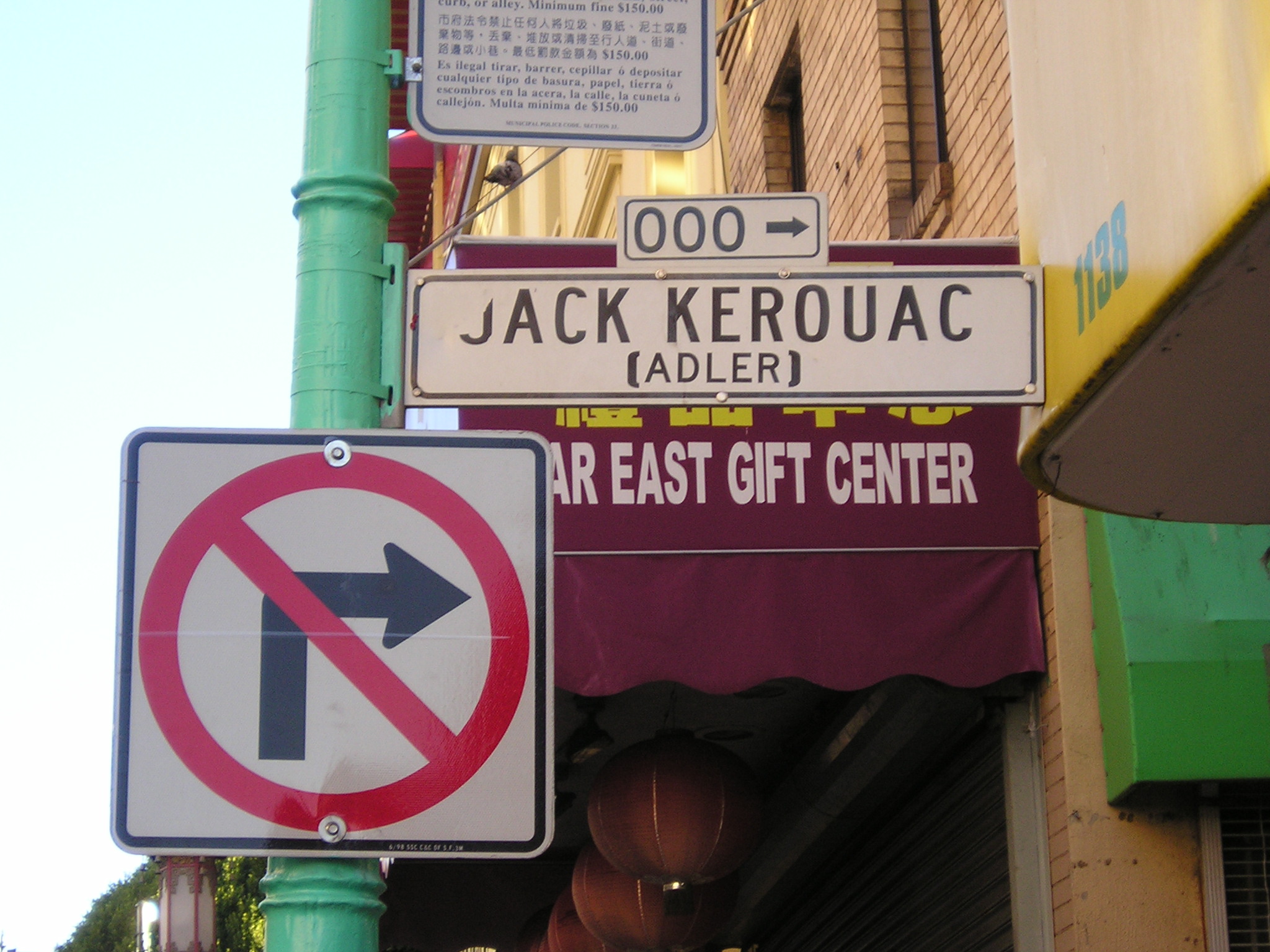
Jack Kerouac Lane, which connects North Beach and Chinatown--no right turns, Jack!

After I returned to the Financial District, a little after 10 PM, I spent an hour or so wandering around North Beach, the historically Italian neighborhood right next to Chinatown. There’s a little alley a block long that runs between City Lights Books and Café Vesuvio and that connects the edge of North Beach with the edge of Chinatown. Formerly named Adler, it has been renamed Jack Kerouac Lane. If one approaches it from the Chinatown side, one is confronted with a big No Right Turns sign just beneath Jack Kerouac’s name. In the last decade of his life, after he had published all of his major work, when he was living with his elderly mother in Florida and heading for an early death from cirrhosis of the liver, Kerouac vocally disapproved of many of his Beat compatriots’ embrace of the 1960s counterculture and the anti-war movement, seeing this as anti-American and against the love of country he had shown in writing On the Road, which he viewed as an ecstatic celebration of America. During one of their last meetings, Alan Ginsberg wrapped an American flag around Kerouac’s shoulders in an ironic gesture. It wouldn’t surprise me at all if one of Kerouac’s old friends in San Francisco arranged matters to have that No Right Turns sign installed beneath Jack’s name.

Oh, how I wish I could've taken this photo at night, with all the neon aglow...

If you’re a fan of neon signage (as I am), North Beach has some of the most spectacular examples in San Francisco. Many of those examples, it turns out, are connected to strip joints. I wandered block after block of Broadway, attracted to glowing neon like a fluttering moth, only to find myself, as a solitary middle-aged man wandering the blue district at 11 PM, on the receiving end of the sales patter of every strip club barker in North Beach. One rather clever fellow fixated on the white collar of my shirt, saying his joint was running “white collar drink specials.” An hour earlier, when I’d been gritting my teeth against the wind near Fisherman’s Wharf, walking back to the cable car, a woman had mistaken me for a priest and asked me to pray for her.

I finished my evening stroll at City Lights Books, which remains open until midnight. I was their last customer. I browsed through a book of polemics on the state of jazz and picked up a copy of An Olaf Stapleton Reader, a collection of the great man’s essays, speeches, short fiction, and excerpts from his novels (published by one of my alma maters, Syracuse University Press). I debated taking the book next door to Café Vesuvio and seeing if they still had any coffee brewing, but I decided I was too tired (and I knew I had to get up early to support computer training the next morning). Even the most wonderful evenings out must eventually come to an end.

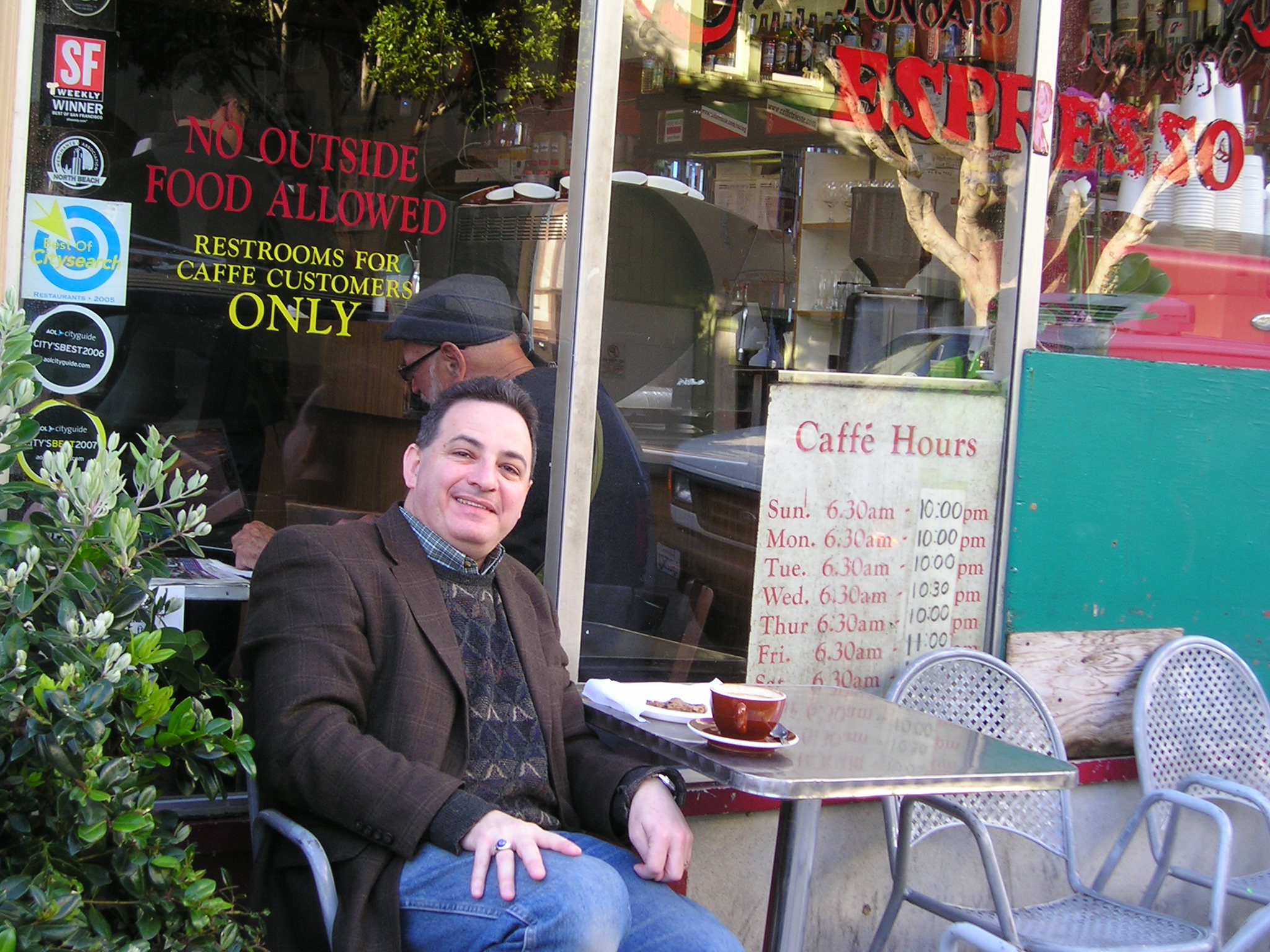
Enjoying the heck out of a cappuccino at the Caffe Trieste

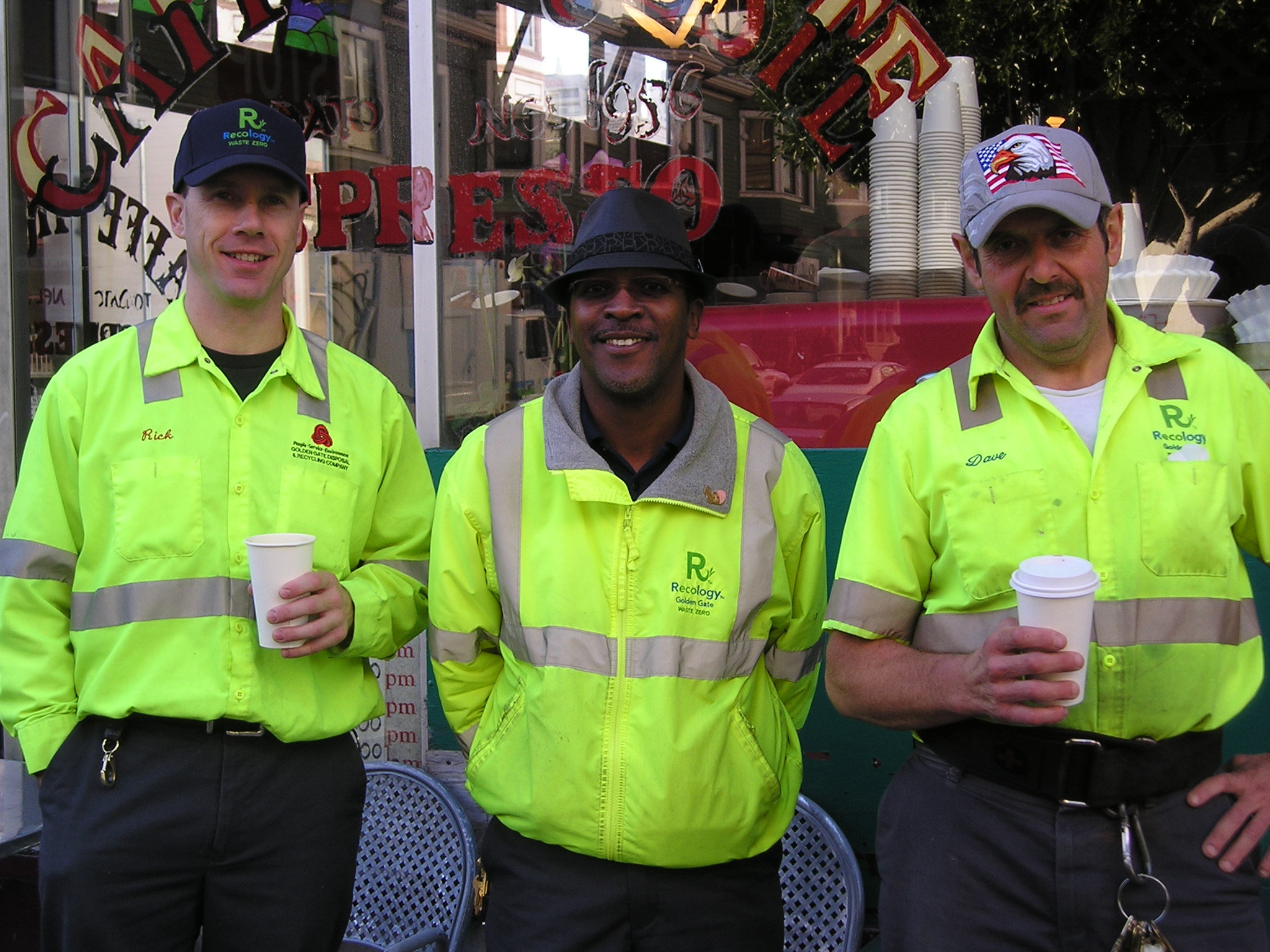
My last morning in San Francisco, I woke up early to make sure I’d have time to have a leisurely coffee and light breakfast at Caffe Trieste, one of the older coffeehouses I’d seen during my nighttime wanderings through North Beach. Caffe Trieste’s North Beach location was established in 1956, and it claims to be the oldest espresso-serving coffeehouse on the West Coast. I didn’t order an espresso, but their cappuccino was first-rate, at least as good as any I’ve had in New Orleans or New York. I sat outside at one of the four small tables in front of the café’s windows and asked one of the three gentlemen sitting next to me to take my picture. Turned out the three fellows were all sanitation workers who work a route that includes North Beach, and they stop at Caffe Trieste most mornings. Great guys with great stories about maneuvering their sanitation truck through San Francisco’s tight, steep, winding streets. They don’t have an easy job, but they seem to like it well enough; one of them, Dave, has been doing it for almost twenty-five years, and the three of them know all the local characters in North Beach.

My sanitation buddies at the Caffe Trieste--Rick, Morris, and Dave

Here’s a short list of food and coffee spots in North Beach, Chinatown, and the Financial District which I patronized and can highly recommend.

Enjoy Vegetarian Restaurant
839 Kearney Street, San Francisco
(415) 956-7868
(This unassuming little restaurant was only a block from my hotel and featured a gigantic vegetarian Chinese menu. I loved the food there so much that, after my dinner there on Monday night, I ate lunch there on Tuesday and Wednesday.)

Tricolore Caffe
590 Washington Street, San Francisco
(415) 391-0509
(Located across the street from the Transamerica Pyramid, this little café is a great breakfast and lunch spot. Their coffee is very good and very inexpensive, with free refills, and their pastries are out-of-this-world good. Michael, the owner, moved to San Francisco from Italy as a teenager. Like me, he is a big fan of Italian writer Primo Levi.)

Caffe Trieste—North Beach
601 Vallejo Street, San Francisco
(415) 392-6739

SF in San Francisco

This past week I had the great pleasure of visiting San Francisco for the first time. I think there are few enjoyments more enjoyable than seeing a vibrant city for the first time, with fresh eyes, when every vista is a new one. Given the briefness of my visit and the fact that I was only able to walk through six of the city’s nearly 120 distinct neighborhoods, San Francisco should provide me with that “fresh vistas” thrill on many subsequent visits, should I be lucky enough to experience them.

My day job sent me to San Francisco, but I was also fortunate to be able to do some business and make some connections concerning the job of my heart – writing, the job that doesn’t pay the bills, but which rewards me through the simple act of doing it.

Jacob Weisman and Jill Roberts of Tachyon Publications

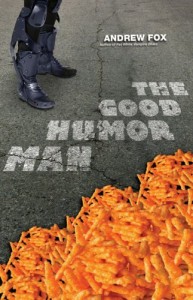
The afternoon I landed in town, Jacob Weisman and Jill Roberts of Tachyon Publications, publishers of my novel The Good Humor Man, or, Calorie 3501, swung by my hotel in Jacob’s little Scion to pick me up and take me back to their office. Turns out their office occupies the first floor of Jacob and Rina Weisman’s three-story home in the hilly part of the city a few miles south of the Financial District, where I was staying. I had a chance to meet Rina (who is a big-time book collector and an absolute hoot), Elizabeth Story, and James DeMaiolo. The whole staff clusters together in a shared workspace with beautiful hardwood floors and some of the most impressive bookshelves you’ll find anywhere (handcrafted by the same talented gentleman who built all the bookshelves at Borderlands Books, as it turns out).

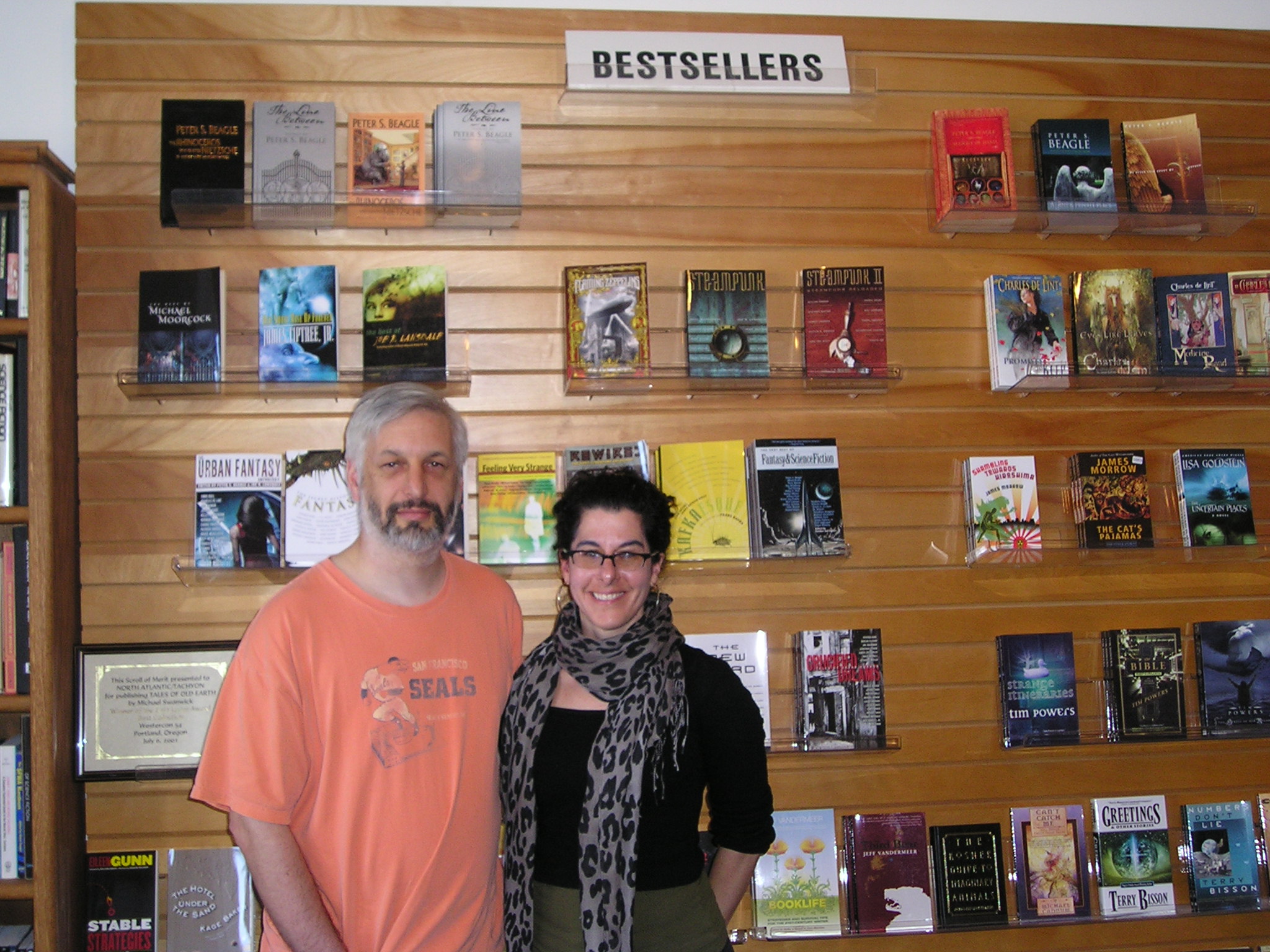
Being in the Tachyon offices gave me a chance to take a look at their entire publishing output all at once. I have to say I was pretty impressed. Running Tachyon is clearly a labor of love for Jacob, Rina, Jill, and the rest of the staff – what they’ve accomplished is to put out a very full, rich line of books for people who both love reading science fiction and fantasy and who are intensely interested in the history and heritage of those fields. One of the very first books they published, back in the mid-1990s, when Jacob was running Tachyon primarily to provide limited edition books for specialty SF and fantasy bookstores (a species of store now very much endangered, unfortunately), was a reprint edition of Stanley Weinbaum’s 1939 novel The Black Flame, with its complete, original text restored. Their more recent output has ranged from extremely interesting (and fun) retrospective anthologies, such as The Secret History of Science Fiction, The Secret History of Fantasy, The New Weird, and Kafkaesque, to nonfiction about the field or some of the field’s most famous practitioners (The Search for Philip K. Dick by Anne R. Dick), to reprint editions of “lost” classics (Lot and Lot’s Daughter by Ward Moore), to “quirky” or “difficult” works by major writers (The Word of God by Thomas M. Disch).

Me standing in front of Tachyon Publication's wall of their bestselling books

It may be a bit self-serving for me to say so, given that they published my most recent book, but I think Tachyon is one of the most interesting publishing concerns going, and they are certainly partial proof that we are living in what may be considered a golden age of small press SF and fantasy publishing. I could certainly envision myself, upon my retirement (whenever that may be… I suspect very far into the future, given the ages of my children), spending a year or two doing little but reading the entirely of Tachyon’s output. And having a grand old time doing so.

Jacob and Jill were kind enough to take me on a stroll around their neighborhood, show off some of the hilltop views of their city and bay, and bring me to a neighborhood coffeehouse for a hot chocolate (Rina insisted I try the hot chocolate) and a pastry. We talked a good bit about Jacob’s and Jill’s careers prior to working at Tachyon (journalism and non-profit fundraising, respectively), the adventures they’ve had working with some of Tachyon’s more, shall we say, opinionated and feisty authors, and what it is like living with a houseful of little boys who can turn Barbie dolls left behind by their older sister victims of monster trucks or dinosaurs or even into light sabers to bonk each other with (this last topic being my contribution). I talked some about my plans to branch out into children’s, middle grade, and young adult fiction this year (I recently wrote a children’s chapter book, The Velveteen Ebook, an updating of the classic story, and I’ve started the first book of what I hope will be a series of middle grade novels set in the world of Mount MonstraCity, The Runaways of Mount MonstraCity).

One thing all three of us have in common is a deep appreciation for the skills of Marty Halpern. Marty has worked as a copy editor on a great number of Tachyon books, and he served as my copy editor for The Good Humor Man, or, Calorie 3501. Although my experience with copy editors is somewhat limited, I’ll go out on a limb and say I think Marty has to be one of the best in the business. The man sweats the details, and ninety-nine times out of a hundred, he is right. I’ve reached the point with Marty that I won’t argue with his suggestions unless I’m darned sure I know what I’m talking about. My wife, Dara, used to work as a copy editor herself, for a pair of technical magazines published in Washington, DC, and when she perused some of the emails Marty sent me, she nearly swooned. “Oh, he’s so good! Oh, he’s so good! Oh, I want to meet this guy!” If I didn’t know Dara as well as I do, I would’ve gotten as jealous as Othello.

Golden Gun Investigations, a couple of blocks from the Tachyon office

When we walked out of the coffeehouse, I looked across the street and saw a business I simply had to photograph – the Golden Gun Investigations agency. Isn’t that quintessentially San Francisco? Don’t you immediately picture a Sam Spade of Chinese heritage working there, smoking Camel after Camel while trading bon-mots with his bored, underpaid, but loyal secretary? I think that place needs to show up in a book published by Tachyon; it’s right in their neighborhood, after all (even though it does bring to mind one of the weaker entries in the James Bond franchise). Maybe Jonathan Lethem could write a follow-up to his first novel, Gun, With Occasional Music. Or maybe I could send Jules Duchon on a trip to San Francisco… after all, his friend and one-time protégé Doodlebug doesn’t live too far away…

Wednesday night I took a BART subway train from the Financial District to the Mission District to do a “meet and greet” and book signing at Borderlands Books. Borderlands is located on Valencia Street, a long commercial strip which in recent years has become a hub for ethnic restaurants, boutiques, antiques outlets, and specialty stores. Jude Feldman, the bookstore’s general manager, welcomed me and ushered me over to the Borderlands Café next door, which opened last year, and provided a much needed cappuccino. Jude is an absolute sweetheart. We discovered a shared love for Robert Mayer’s wonderful superhero farce Superfolks, and she introduced me to a number of the store’s regular patrons. Unfortunately, she had to boot me and the gang from Tachyon out through the front door before I’d had a chance to peruse more than half their selection of new and used books – it was closing time! But I had a chance to pick up a copy of Michael Bishop’s Philip K. Dick is Dead, Alas and a couple of vintage Philip Jose Farmer paperbacks before getting the boot.

Borderlands Books (with Borderlands Cafe to the left)

One interesting side note about the Borderlands Café – it doesn’t feature wi-fi, and that was by design. Jude mentioned to me that, not long after the café opened, she’d surveyed the customers to find out how much they wanted wi-fi to be available. It turned out that many of them, particularly the writers among them, didn’t want it at all… they wanted to have a place to hang out where they could escape the Internet and the siren song of social media. I’ve found an even easier way myself to avoid the Internet when I want to do real work: I do all my writing on a Mitsubishi Amity laptop from 1997, which won’t run anything more modern than Windows 98 (and, in fact, all that I run on it is DOS 6.1 and WordPerfect 5.1, that classic word processor which will have to be torn away from my cold, dead, stiff fingers – I feel the same way about WordPerfect 5.1 that Harlan Ellison feels about manual typewriters).

Rina and Jacob Weisman

After Borderlands closed for the evening, Jacob, Rina, Jill, and a friend, Jeremiah, took me out to a Thai restaurant a few blocks away. I discovered that Jacob and Rina had hooked up the same way Dara and I had – through JDate.com (although they had met previous to their electronic hook-up, when Jacob had made the error of wearing his bar mitzvah ring on his left ring finger, mistakenly signaling to Rina that he was married; her finding him on JDate cleared that up). Jill revealed that she had met her boyfriend while they’d both been engaging in indoor rock climbing (he had charmed her by swinging like Tarzan on a safety rope). The food was quite good, by the way… I’ll prevail upon Jill to remind me of the name of the restaurant, in case anyone needs a recommendation for good Thai food in the Mission District.

One more little note before I bring this post to a close (I’ll be writing more in a day or two about my nighttime gambols through Chinatown, North Beach, and the Fishermen’s Wharf area). While I was on my trip, I made use of the long in-flight times to work on a short story to submit to Claude Lalumiere’s upcoming anthology of tales about books, book collecting, reading, and writing, Bibliotheca Fantastica, scheduled to come out late in 2012. My story centers on a mostly unsuccessful science fiction writer whose earliest claim to fame was being chosen First Runner Up in the 1985 Writers of the Future contest. Writers of the Future is an annual contest and anthology which has given many science fiction and fantasy writers their first rung up on their climb to professional status. It was founded by L. Ron Hubbard in 1983. Writers of the Future has always had a double-edged reputation in the science fiction field; many writers and readers are grateful to the contest for midwifing so many promising careers but are a bit leery of its sponsorship, given the somewhat shady rep of Hubbard’s Church of Scientology.

Transamerica Pyramid

Anyway, I’m walking to my temporary work location a few blocks away from my hotel, and I stroll right past the famous Transamerica Pyramid building, built between 1969 and 1972 (and briefly the tallest building west of the Mississippi River, before being eclipsed by the Aon Center Building in Los Angeles in 1974). While waiting for a traffic light to change, I glanced across the street at a striking triangular-shaped building which looked like a smaller version of the Flatiron Building in the Manhattan (home of Tor Books, by the way). Large letters on its side read, “Transamerica Corporation.” Even bigger letters on its front spelled out, “Church of Scientology.” Turns out this was the original headquarters of the Transamerica Corporation, prior to the Transamerica Pyramid being built, and it became the headquarters of the San Francisco Church of Scientology in 2003.

original Transamerica Building, now the HQ of the Scientology Church of San Francisco

Here’s what the online Fodor’s Guide to San Francisco has to say about the building I photographed:

“The original Transamerica Building is a Beaux Arts flatiron-shaped building covered in terra cotta; it was also the home of Sanwa Bank and Fugazi Bank. Built for the Banco Populare Italiano Operaia Fugazi in 1909, it was originally a two-story building and gained a third floor in 1916. In 1928, Fugazi merged his bank with the Bank of America, which was started by A. P. Giannini, who also created the Transamerica Corporation. The building now houses a Church of Scientology.”

Friday Fun Links: Amazon vs. IPG, Updated

800 lb. gorilla

I apologize in advance if these “Friday Fun Links” are less fun than the ones I usually post. But I wanted to update my readers and friends on the current status of the Amazon versus IPG (Independent Publishers Group) standoff. In what has widely been viewed as a David versus Goliath conflict, scrappy little IPG continues to hold their ground, not knuckling under to Amazon. However, this means that over 5,000 ebooks published by companies distributed by IPG — including Tachyon Publications, publishers of my The Good Humor Man, or, Calorie 3501 — continue to be made unavailable by Amazon (although Kindle editions are available from other online retailers and directly from IPG).

Considering Amazon’s enormous (and growing) power in the publishing marketplace, this story has the potential to impact many, many more people than just the employees of IPG and the small publishers whose books they distribute, the authors of those books, and those books’ readers. If Amazon can succeed in driving its smaller competitors and partners from the marketplace, readers and writers alike will be at the company’s mercy, which does not bode well for the future of a thriving intellectual market in the United States or, given Amazon’s worldwide reach, much of the rest of the Western world.

Amazon vs. Indie Publishers: IPG “not budging”

Amazon’s Assault on Intellectual Freedom

Amazon’s Squeeze on Booksellers Leads to Boycotts and Protests

The Science Fiction and Fantasy Writers of America Protests Amazon’s Yanking Kindle Availability of 5,000 Books, Many of Them SF and Fantasy

Jacob Weisman, owner of Tachyon Publications, responds to SFWA’s move

A Simple Explanation of Wholesale versus Agency Pricing of Ebooks

Pohl + Kornbluth, Part 4: Two Solo Novels, The Syndic and Drunkard’s Walk

Return to Introduction
Return to The Space Merchants
Return to Search the Sky

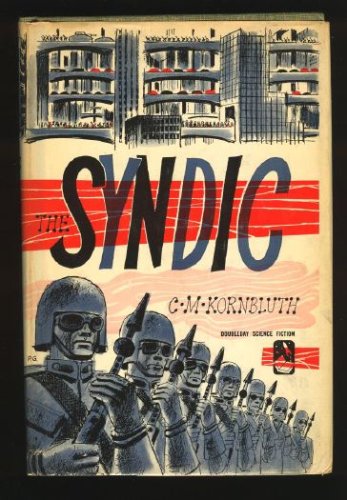
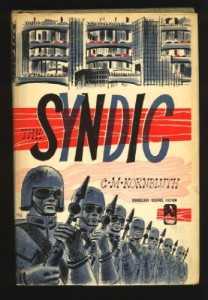
The Syndic
by C. M. Kornbluth
Original publication: Doubleday, 1953
Most recent publication: Armchair Fiction, 2011 (paperback double novel, included with Poul Anderson’s Flight to Forever); Wonder eBooks, 2009 (Kindle edition)

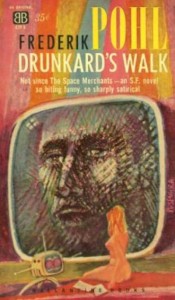
Drunkard’s Walk
by Frederik Pohl
Original publication: serial publication in Galaxy Science Fiction, 1960; Ballantine, 1960 (paperback original); Gnome Press, 1960 (hardback)
Most recent publication: Granada, 1982 (British pb)

Although their most famous and enduring work of the 1950s remains the novels that they wrote together, both Cyril Kornbluth and Frederik Pohl published numerous other books during that decade, both solo works and novels which they wrote with other collaborators (Kornbluth with Judith Merrill, and Pohl with Jack Williamson and Lester Del Rey). Kornbluth’s best-remembered solo novel of the decade is The Syndic, and Pohl’s best received solo novel of that period is Drunkard’s Walk (his only other solo novel of the decade was Slave Ship from 1956; solo novels from Pohl would remain relatively rare until the latter half of the 1970s, when his career experienced a second blooming).

By taking a look at these two solo novels, each written either during or shortly after the period of their most intense and sustained collaboration, we may be able to acquire a better sense of what qualities each partner brought to the collaboration. We may also get a clearer idea of both men’s weaknesses as novelists during this time in their careers, which will help us to better understand how their strengths were complementary, and how this complementariness contributed to the classic status of three of their four shared novels.

Fred Pohl had this to say about Cyril Kornbluth’s assets and weaknesses as a writer:

“Cyril had a nearly in-born gift for graceful writing and excellent spot-on characterization. His only real weakness was in plotting. By then he had taught himself — maybe with a little help from those Futurian writing orgies — plot structure for short stories and, soon thereafter, novelettes and novellas. Some of his work from that period I would match against almost anybody’s best stories ever, including ‘The Marching Morons,’ ‘Two Dooms’ and a good many others.”

It is very likely that Fred Pohl knew Cyril Kornbluth as well as anyone. How do Pohl’s observations above match up with what can be observed in Kornbluth’s best-known solo novel, The Syndic?

Pretty well, I think.
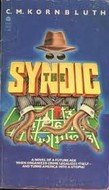
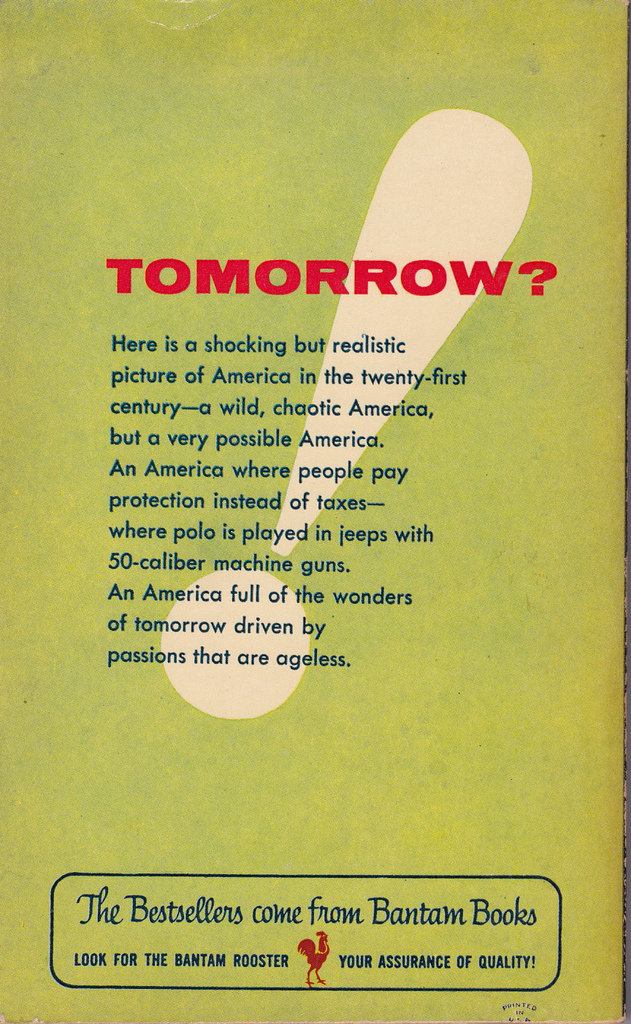
The Syndic’s central idea, that of a future American society based on anarcho-capitalism, in which organized crime has booted out the federal government, legalized itself, and runs things in a surprisingly humane fashion, is a sturdy one for a science fiction politico-satire. The Syndic is variously described by its members as “an organization of high morale and easygoing, hedonistic personality” and “an appropriately structured organization of high morale and wide public acceptance,” never as a government. The book may be viewed as one of the stronger extrapolations of libertarian social and political ideas in science fiction, and it has been awarded a Hall of Fame Prometheus Award by the Libertarian Futurist Society in 1986.

The novel’s central characters are fairly well sketched out and appealing. Charles Orsino, the hero, is a low-level bag man for the Syndic, a young man painfully aware of his low rank in the organization but who is loyal to a fault. His uncle, Frank Taylor, a financial administrator for the Syndic and a social theorist, the author of Organization, Symbolism, and Morale, is a humorously crusty old curmudgeon who obviously has a big soft spot in his heart for his nephew. Lee Falcone is a stand-out in that she is portrayed as both a highly competent woman professional (a psychologist) with an important role in the Syndic and as an attractive and desirable potential love interest for Charles (not a crone or a spinster or a battle-ax), a combination rather rare in science fiction during the period in which the book was written. A secondary character, Martha, a young, telepathic “witch” of a primitive Irish tribe, is especially appealing, a fascinating mix of naiveté, youthful over-confidence, willfulness, heroism, and sweetness. The novel’s primary villain, Commander Grimmel of the exiled North American Government’s Office of Naval Intelligence, is a less well-rounded character, but, even so, may be viewed as more carefully and intelligently drawn than most of the heavies which tormented the heroes of 1950s science fiction novels.
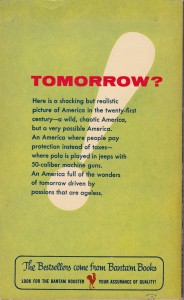
Several of the novel’s set pieces are especially well-written and gripping. The scene in which Charles and a junior officer of the North American Navy are surrounded in the Irish wilderness by a hostile tribe of pagan savages and must defend themselves with a dismounted fifty caliber machine gun is loaded with telling details, suspense, tension, and atmosphere. Cyril Kornbluth makes excellent fictional use of his personal experiences lugging a machine gun around the Ardennes Forest during the Battle of the Bulge. Also very good is the description of Charles’ amnesiac sojourn in the lower depths of New York’s waterfront while he is under the induced delusion that he is Max Wyman, a man who hates the Syndic and wants more than anything to become an agent for the North American Government; Wyman is an invented personality temporarily grafted to Charles by Lee Falcone in order to allow Charles to infiltrate the North American Government and learn whether that entity is behind the assassinations and attempted assassinations of Syndic family members (including an attempted hit on Charles himself). The waterfront scenes are very atmospheric, reminiscent of the work of the best noir writers of Kornbluth’s day.

Kornbluth also showed a deft touch with humor. Charles’s interactions with a woman shopkeeper from whom he collects what we would think of as protection money is both funny and nicely revealing of the relationship between the Syndic and much of the American population east of the Mississippi. When Charles is undercover in the North American Government’s stronghold in Ireland, I smiled at his reactions to the relatively puritanical sexual mores he discovers there, in contrast to the easygoing and open physical relations between the sexes he has become used to back home. One of the best humorous exchanges occurs during a high ranking Syndic family strategy meeting, where Uncle Frank describes the current state of much of Europe, which had no organization capable of picking up the pieces after traditional governments atrophied and died of their own bureaucratic sclerosis:

“‘The forests came back to England. When finance there lost its morale and couldn’t hack its way out of the paradoxes, that was the end. When that happens you’ve got to have a large, virile criminal class ready to take over and do the work of distribution and production. Maybe some of you know how the English were. The poor buggers had civilized all the illegality out of the stock. They couldn’t do anything that wasn’t respectable. From sketchy reports, I gather that England is now forest and a few hundred starving people. One fellow says the men still wear derbies and stagger to their offices in the City.

‘France is peasants, drunk three-quarters of the time.

‘Russia is peasants, drunk all the time.

‘Germany–well, there the criminal class was too big and too virile. The place is a cemetery.'”

The novel’s primary shortcomings seem to me to be in the area of plotting. Kornbluth ends The Syndic on a weak note, a philosophical dissertation by Uncle Frank on the proper limits of anarcho-capitalism which, although interesting and sure to provoke discussion among sociologists and political scientists, brings the book to a close on what is, dramatically, at least, a damp squib. Nothing is resolved. The only takeaway is that the North American Government and the Mob are working together against the Syndic is some ways, which does not come as much of a revelation, given information which was shared early on in the book.

A couple of plotting elements irked me particularly, but may not trip up other readers. I ended up confused by the sequences in which Charles Orsino initially goes undercover. The way the material was presented, I assumed that his invented identity, Max Wyman, is an actual person, and that Charles has inadvertently been put in great danger by Lee Falcone by being given the identity of Wyman, since both Wyman and Charles would be joining the North American Navy at about the same time. I kept waiting for “the real Max Wyman” to make another appearance in the book and precipitate a crisis for Charles and Lee. What happened is that I missed a one-sentence tip-off that Wyman is an invented personality; I didn’t discover my mistake until I reached the end of the book and, perturbed by Wyman’s failure to make a second appearance, went back to the chapter where the identity had first been introduced. Then I whacked myself on the forehead and went, “Duh!” Yet then I realized that, had Kornbluth been a little more clear, if he had perhaps arranged his scenes a bit differently, I would have avoided my mistake. The other element which disappointed me was Kornbluth’s killing off of my favorite character, Martha, the adolescent, telepathic “witch,” to little purpose. Martha and her abilities are a bit of a “bridge too far” for the novel, which didn’t need the introduction of an additional (and non-central) fantastical idea like telepathy. But once she was introduced, I very quickly came to like her, and I looked forward to Charles bringing her back to the land of the Syndic, where she might serve a novelistic role similar to that of John the Savage in Aldous Huxley’s Brave New World. Instead, she gets killed off in a melodramatic and unnecessary fashion. I missed her.

Unfortunately, no quotes from Cyril Kornbluth survive which would indicate what he had thought of his friend Fred Pohl’s strengths and weaknesses as a writer. Early in his career, Pohl was greatly attracted to collaboration, at least when working on novels; the only solo novel he published during Kornbluth’s lifetime was Slave Ship in 1956. However, Drunkard’s Walk, his next solo novel, appeared slightly less than two years after Kornbluth’s untimely death. Given that it was touted as a satirical science fiction novel in the vein of The Space Merchants and that it is better remembered than Slave Ship, let’s take a look at this book and compare its virtues and shortcomings with those of The Syndic.


Drunkard’s Walk was originally serialized in a shorter form in Galaxy Science Fiction in 1960. Pohl’s novel has the feel of a typical late-1950s Galaxy story: a surface urbanity and wit, many clever turns of plot, and characterization about as deep as that found in a Twilight Zone episode of the same era. The novel-length Drunkard’s Walk, although not a long book, suffers some from excess padding glued to its flanks during the effort to expand it from a novella to a novel; many of the chapters told from the vantage point of a supporting character, Master Carl, feel tacked on and unnecessary. The primary problem faced by the protagonist, Master Cornut, a mathematics professor at an unnamed University, is both original and compelling—during periods of partial consciousness, such as when he is on the verge of falling asleep, has just woken up, or is distracted by the progress of one of his own lectures, Cornut is plagued by an autonomous compulsion to commit suicide, despite being a happy, privileged, and well-adjusted individual. He is forced to rely upon the watchfulness of those who live adjacent to his on-campus living quarters, initially students and later his student wife, to keep himself from slitting his own throat or hurling himself over the railing of his apartment’s balcony. Where the plot ultimately heads is less fresh, at least from the present vantage point of an additional half-century of science fiction stories and films, involving as it does the trope of a conspiracy of secret immortals who seek to wipe out potential rivals before those rivals can realize their own power.

For today’s reader, the primary draw of Drunkard’s Walk may be its setting, the University where Master Cornut teaches. Pohl paints the University as a refuge from the overcrowded, tumultuous outside world, where a sizable portion of the American lower middle class is forced to live on “texases,” off-shore platforms originally constructed as early-warning radar installations, which are now used for dirty jobs such as manufacturing and raw materials processing (each texas produces its own power from the wave energy that crashes continuously against its support legs). Pohl is very skillful at extrapolating a future society and delineating its most colorful details; the future world of Drunkard’s Walk is as colorfully described as that of The Space Merchants. Pohl places the University’s professors, or Masters, at the top of his social pecking order. Masters may take advantage of a sort of droit de seigneur regarding the University’s students. Conjugal relations between professors and students are encouraged, being viewed as beneficial to each, and what are called “term marriages” are common, which may last (presumably on the Master’s prerogative) as briefly as a few weeks. There is a strict separation between Town and Gown, with the latter acting in many ways as a sort of hereditary landed aristocracy, but one which sometimes opts to absorb very talented members of the former into its ranks (as scholarship students). The book’s most accurate prediction is Pohl’s envisioning of distance learning; each professor’s lectures are taped and broadcast, reaching audiences of millions, those who either aspire to degrees of higher learning or who desire access to knowledge.

With Drunkard’s Walk, Pohl showed off his mastery of the clever turns of plot possible within the bounds of a science fiction novel. As a writer of science fiction novels myself, several times while I was reading the book, I found myself stepping back in admiration and doffing my metaphorical hat to Pohl’s skill and cleverness in twisting his plot. (Skip the remainder of this paragraph if you wish to avoid a major spoiler.) The resolution and climax of the novel revolve around the notion that a small group of telepathic human immortals has been secretly manipulating history and society to benefit themselves and to remove potential threats to their hidden dominance. It turns out that Master Cornut is one such threat, as, unknown to himself, he is a potential telepath. His unmotivated suicide attempts are actually the result of telepathic suggestions beamed at him by the immortals on campus, who wish him to remove himself. Even more clever is the immortals’ plot to winnow down the burgeoning population of non-immortals (the world of Drunkard’s Walk is just as overpopulated as that of Harry Harrison’s Make Room! Make Room!). Using their telepathic abilities, they erase all memories from the human race of small pox and how to make a vaccine, saving that knowledge for themselves only. Then, in their roles as heads of Master Cornut’s University, they organize a sociological expedition to a South Pacific island where descendants of soldiers of the Imperial Japanese Army have formed a primitive, militaristic tribal society, hidden in the jungle since the end of the Second World War. All of the members of this tribe have been exposed to small pox, which has been eradicated (and then forgotten) in the world outside the island. The immortals take members of the tribe on a lecture tour all over the globe, encouraging them to spread small pox throughout every population they come into contact with by selling their ancient uniforms and flags as souvenirs and by sharing a pipe of peace – reflections, of course, of how small pox was spread through the Native American population by European settlers. They succeed in starting an epidemic, which only Master Cornut’s intervention is able to halt, although only after millions of people have died.

I would argue that Drunkard’s Walk is more skillfully plotted than The Syndic, and its future world is more fully extrapolated. Where does the book fall down in comparison with Kornbluth’s novel? Primarily in the area of characterization, I’d say. Many of the two books’ characters can be viewed as counterparts, and in each comparison, Kornbluth’s characters feel more rounded and fully realized than Pohl’s characters. As a young hero-protagonist, Kornbluth’s Charles Orsino is more appealing, magnetic, and interesting than Pohl’s rather bland Master Cornut. In the role of elder advisor and provider of knowledge, Uncle Frank is much more intriguing than Master Carl, who comes across as a self-involved old bore. Similarly, Charles’ romantic interest, Lee Falcone, is far more three-dimensional than Master Cornut’s student-wife, Locille (although Locille has her appealing qualities, too). There is less differentiation between the quality of characterization of the two novels’ villains, although there again I would give the edge to Kornbluth’s villains (Pohl’s lean a bit too much toward the mustache-twisting variety).

Although Drunkard’s Walk was marketed as a satirical comedy – the blurb on the original Ballantine Books paperback edition reads, “Not since The Space Merchants — an S.F. novel so biting funny, so sharply satirical” – I found that the book’s humor fell flat. Unlike the humor found in The Syndic, which has held up well, the gibes in Drunkard’s Walk feel dated and forced. Also, although Pohl’s novel ends in a paramilitary assault on the immortals’ stronghold, his book contains no action scenes nearly as gripping or as richly portrayed as the battle scene Kornbluth set in rural Ireland.

What can we discern from this comparison of The Syndic and Drunkard’s Walk? Regarding the relative contributions of Frederik Pohl and Cyril Kornbluth to their shared novels, I would venture to say that much of the credit for those novels’ plotting, world building, and social extrapolation should probably be given to Pohl. However, I suspect that a goodly portion of those books’ rich characterizations (especially in contrast to the sketchy, minimal characterization found in so many of their contemporaries), their humor, their physical descriptions of settings, and their action sequences can be chalked up to Kornbluth’s input.

At this point, only Fred Pohl could say for certain. And considering the more than half-century that separates those novels’ composition from the present day, even he might have difficulty sorting out who contributed what.

Next: Gladiator-at-Law

Surrendering to Reading Glasses

Well, I’ve crossed a Rubicon, I suppose. After many, many months of putting it off, telling myself the eye strain wasn’t too bad, and willing my arms to grow just a bit longer, I finally walked into Walgreen’s and bought myself a pair of reading glasses.

I knew I couldn’t put it off any longer this past week in San Francisco, when, after a six-hour flight, I spent a couple of hours browsing in City Light Books and nearly fried my eyeballs. I read through their jazz books and eclectic science fiction section until I simply couldn’t focus on the print anymore. I tried chalking it up to exhaustion after the flight, or maybe to my eyes being sensitive to some West Coast pollen I hadn’t encountered before. My eyes were still throbbing the next morning. My second browsing visit to City Lights wasn’t quite as painful, but it wasn’t great, either. Then, this morning, after I dropped my boys off at Sunday school and went to a nearby Starbuck’s to read for a while (Philip Jose Farmer’s Flesh, which I’ll be sure to blog about) before heading back to join them for their Purim carnival, I just wasn’t able to concentrate on the prose. Reading had become a physical ordeal. My arms were too short to box with Philip Jose Farmer. When I left the Starbuck’s, I headed straight to Walgreen’s.

Why did I put off an obvious physical need for so long? It’s not so complicated. Oh, there’s my slightly wounded pride… but, hey, being able to put off wearing reading glasses until the age of 47 isn’t exactly an unconditional surrender to the weaknesses of middle age; I put up a decent fight. And I’ve still got most of my (original) hair. No, my unwillingness to buy a pair of reading glasses had much more to do with, not my loss of youth, but my memories of youth. Specifically, my memories of junior high school. The only other time in my life I’ve worn reading glasses was during seventh through tenth grades. The worst years of my life, by far. The reading glasses weren’t the cause of my misery. But I associate them with endless humiliation, degradation, and self-loathing. I was enormously happy when my vision self-corrected and the optometrist told me I could stop wearing glasses.

Oh, well. Time to man up. I love to read. It is one of my greatest pleasures. Reading once again with reading glasses sitting on my nose feels like taking a shower wearing galoshes. But I suppose the oddness will eventually wear off, and slipping the reading glasses out of their case will come to feel as natural as drinking my first cup of coffee in the morning or pulling on socks. Just so long as I don’t have to have braces put back on my teeth or spend another hour, ever, at Thomas Jefferson Junior High School…

(By the way, since we’re on the subject of encroaching middle age, this past week I bought a copy for a friend of my all-time favorite depiction of how the diminishments of middle age might affect a superhero, Robert Mayer’s absolutely wonderful novel Superfolks, now back in print.)

Eclectic Taste in Films

As a member of the Loyola University English Department’s Advisory Board, I receive many news announcements from my alma mater. I was sad to see this announcement of Professor Peggy McCormack’s untimely passing. I never had the pleasure of taking one of Professor McCormack’s classes, but I was an avid attendee of the Loyola Film Buffs Institute’s film screening series. I got my first exposure to such classics as Rashamon, The Seventh Seal, and Nights of Cambiria in the little auditorium on the third floor of Bobet Hall.

Usually, notices of memorial events don’t generate a smile or a laugh. This one did. See if you agree.

Tribute to Professor Peggy McCormack

Peggy McCormack, Ph.D., Loyola University Professor of English

Dear Loyola Community,

Professor McCormack who was a vivacious contributor to Loyola’s campus life for several decades passed away unexpectedly on Mardi Gras day 2012.

As a senior professor in the Department of English and a longtime director of Loyola University’s Film Buffs Program, she left a deep and cherished imprint on the lives of many students. She will be dearly missed.

To celebrate her legacy and to commemorate the inspiring friendships that she shared with many of her students, Film Buffs will show two of her all-time favorite films on March 9: Sunset Boulevard and The Texas Chainsaw Massacre.

A Story from My Fannish Youth: Sheepish Labyrinth

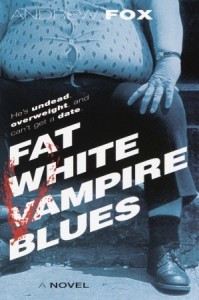
Most writers I know are compulsive recyclers — of words. I always save the “out-takes” of my novels, scenes or bits of dialogue that I like (sometimes like a lot), but that I’ve cut for reasons of length or because they seem superfluous to the story at hand. There’s always a chance that I may reuse that scene, minor character, setting or monologue or dialogue exchange in some future novel or story. I remember using a number of bits and pieces I cut out of Fat White Vampire Blues in Bride of the Fat White Vampire, and major chunks of a long short story, “Relics” (which I’ll eventually get around to posting on this site), ended up as parts of the Miami Beach chapters in The Good Humor Man, or, Calorie 3501.

My most recent bit of recycling sent me back to my earliest publishing effort, a fanzine called The Dragon Reader that a group of buddies and I put out in August, 1980 when we were between our sophomore and junior years in high school. I’m presently writing a short story to submit to one of Claude Lalumiere’s upcoming anthologies, Bibliotheca Fantastica (“stories having to do with lost, rare, weird, or imaginary books, or any aspect of book history or book culture, past, present, future, or uchronic”). The first story I wrote with the intention of submitting to Biblioteca Fantastica, “The Velveteen Ebook,” ended up turning into what might be marketed as that odd bird, a children’s chapter book aimed at adult readers. I still wanted to submit a story to Claude, however, and I happened to remember a very old story of mine, one of my first, that I’d written when I was fourteen. I didn’t want to submit that entire story (called “Cliffside”) to Claude, but I wanted to use a part of it as a fragment of a story within a new story, about a middle-aged writer on the verge of giving up, who is confronted with his teenaged son’s girlfriend, an aspiring fantasy writer who is every bit as good as he was at her age… maybe far better.

Anyway, while cribbing from “Cliffside” in that 32 year-old fanzine of mine, I came across a much shorter piece that I actually like a whole lot better than “Cliffside” (although back in 1980, soon after I’d written the pair of stories, I thought “Cliffside” was a masterpiece and “Sheepish Labyrinth,” the story I reprint below, was small beer in comparison). “Sheepish Labyrinth” was the result of a writing exercise that my pals Larry Lipkin and Preston Plous and I engaged in during one of what we called our Write-a-thons, all-night writing and science fiction role-playing sessions we’d put on at one of our houses sometime between our eighth and tenth grade years. This particular writing exercise, the noun-adjective exercise, to the best of my knowledge, was invented by Ursula K. Le Guin; in any case, I borrowed the technique from her book of writing exercise stories, The Altered I: Ursula K. Le Guin’s Science Fiction Writing Workshop.

It’s very simple (and surprisingly effective for producing new ideas). You and your friends write up lists of 30-40 nouns and 30-40 adjectives, the more colorful, the better. Then cut each word out, fold them in half, and put each in one of two hats, a nouns hat and an adjectives hat. Each writer picks out three pairs of nouns and adjectives. You then have to write a story based around a title utilizing one of your word pairs.

My noun was “labyrinth.” My adjective was “sheepish.” This is the story I wrote that night (amazingly, without so much as a sip of coffee, because I didn’t drink coffee back then… ah, the boundless energy of youth!).
_____________________________________________________________________________

Sheepish Labyrinth

* * * *

There it walks. A solid wind blowing by from places unimaginable, carrying sounds and other ripples in its current — click, clack, click, clack, its heels striking me, the sound rebounding. Another little man. Another little man and another little flickering shadow, the dark outline creeping warily across my floor. They’re an odd pair, the shadow and the man; the shadow creeping bolder now, only to leap to its protective master when I threaten to blot it out; the man walking hurriedly across me, unaware of its brother’s plight.

Where from this time? I do not know. It moves, it seems to live, in a fashion; surely then it is from Somewhere. I am me; that which is Outside is not. Of me the man is not, being neither floor, nor wall, nor even air; thus the man must be from Somewhere Outside.

Does it matter? It is in me, and it is warm. Its feet tickle my floor, and my walls are dampened by its breath. Dampness is strange, yet not unpleasant strange… little drops, many little men walking my walls… The man turns one of my corners, and then another, and another. It is walking in a circle. Little man, will you never find my end? I growl a bit, and its leg wobble. I am hungry. I growl again, and it begins to move faster — run. Its second layer — clothes? — flails out behind it, and sets of creases form and disappear and change shape. Its face — no, her face, her face, yes — too changes, from light to glowing darkish, from tan to white to crimson. Little blotches appear — how wonderful, how different from Outside, always black.

I growl and heave, and she falls. A deep red flows from the middle of her face and slowly follows the creases, and fills the pores. Little lines appear in the whites of her eyes. I want to watch, but I am hungry. An empty place in me rumbles, wanting to be filled — I feel the emptiness; yet I am not vacant. Perhaps I should pull myself inwards, and the man and I could fill the space, and stop the crying. But to have to push, and pull, and push…

The little man has gotten up. She leaves red on my floor, and I am happy. I am happy and I am hungry, but I will make the empty place wait. I will rest from heaving, and I will watch the man. My empty place screams, and I tremble at the feel of it. I tremble, I cringe, yet with the fear there is another — a… a joy. It is the man. She runs, not down my passages, but towards my walls. Again the strangeness (a cause and effect that should not be) — my fear was the instrument of the joy, for in my very trembling I had forced an opening, a hole in myself, and it is towards this hole that the man runs. She runs, yet it is unlike the time before; she runs with joy, joy and something beyond joy, a joy beyond joy and beyond my very knowing, a happiness, a flight — a love, a love for… for Life itself. She runs, and her body, her feet, are strangely warm, and the warmth in her feet melts them into my floor. I swell with added essence, and she obliges me, wave after wave of joyful emotion flooding her senses, bloating her, swirling about our feet/floor, growing, spreading even to the empty place, until, at last, together we fill me.

Filled, fullness… to be unalone, to be… whole? Whole. Hole-whole. Hole in me opens her joy, binding us, making me… whole. A circle, a closed line, that directs my passages and, seemingly, the flow of time’s events. Flow, drift; something’s floating by, drifting in… sound? No, sound touches, tingles… but it is sound, sound and seeing; sound without feel… seeing without light… thought. Thought: a blue whale is swimming in a gold-rimmed, pink bathtub. This cannot be. But why? Perhaps because whales are big, and no bathtub, even if gold-rimmed and pink, could hold one. Yet I saw it; it was so in my thought… thought… sense without feel, without light, without reality… Perhaps thoughts are unreal?

And what do I know of whales? Until an instant ago, whales did not exist; yet I think them, I know them — blue-black immensities, drifting contentedly through dark, chilled oceans; oceans like mountains of moisture, pleasant, strange dampness… little drops, little drops walking my walls, born of the breath of the man… breathing out drops… thinking out… whales. Breathing out; thinking out — a giving. Sharing. The whales are hers, and now they are mine, too. She is sharing with me. What was the difference between clear droplets and a redness left on my floor… but she knows… and I know, too… She is sharing with me! Light and darkness, the lonely ends of sight, they’re not alone, even as I’m not alone, the vastness between them is filled with color, color… A she and a he, so separate, so alone, join together, to birth another out of abandoned loneliness… Clothes, clothes to keep the cold out… Warmth, joy, love… love… hole. The hole, mine to share, which gave her joy… the man… she is still running… running away… but we… we are joined, I thought it, I saw it in my thought… thought… thoughts are… unreal… why

Stay; stay, little man, share the warmth, and together…

Now she is Outside, and I am empty once more. The empty place gathers up its voice to scream again. The deserted redness sinks into my floor, and with it a last glimmer of happiness. The scream unleashes itself, and I await another little man.

Appearing at Borderlands Books in San Francisco

My day job is sending me to San Francisco this week to support a couple of days of computer training. This’ll be my first opportunity to visit San Francisco, home to lots of Beat Generation history and many, many albums’ worth of classic West Coast jazz (as well as one of Ray Harryhausen’s early monster classics, It Came From Beneath the Sea).

My good friends at Tachyon Publications set me up for an informal book signing at Borderlands Books on Wednesday evening. I’ve met the nice folks from Borderlands Books before, but at conventions (pretty sure I chatted with them and shopped their wares at the 2010 NASFiC in Raleigh, North Carolina), never at their store.

Book Signing and Meet-and-Greet at Borderland Books
Wednesday, March 7, 2012, 7:00-9:00 pm
866 Valencia Street, San Francisco, California
(415) 824-8203

I hope a few of you will be able to drop by on Wednesday, or have friends in the San Francisco area to whom you could pass along the word. I’ll be staying at the Hilton in the Financial District, right next to Chinatown, not far from the waterfront, and only about four or five blocks away from City Light Books and Cafe’ Vesuvio, two classic Beat hangouts. Although it’s never easy to be apart from my family, I’m really looking forward to the trip and to seeing places that, until now, I’ve only read about (not just the Beat spots, but also Philip Marlowe’s haunts in The Maltese Falcon). Thanks, work!

Great Kids’ Books from MystiCon

Danny Birt, doing his heroic thing

My family and I really enjoyed attending MystiCon in Roanoke, Virginia this past weekend. It’s very gratifying to me to be able to say this, considering that the volunteer who was scheduled to run most of the children’s activities track got sick prior to the con, and those activities had to be canceled. Even so, my kids were very welcome in the dealers’ room, the con hospitality suite, and (most important to them) the video gaming room, which featured various games and gaming consoles going all the way back to the 1980s.

In fact, my best memory of the con, apart from two terrific (but sparsely attended) panels on Sunday, is of the Saturday night children’s story hour in front of the hotel’s fireplace in the lobby. Alethea Kontis and Deborah Smith Ford read from their picture books to a very appreciative audience of about eight children (three of whom were my boys), who sat on pillows in front of the fire and were quite vocal with their reactions and questions. After the story telling was over, a kind (and incredibly patient) con organizer wandered over with a beginners’ level fantasy board game and taught the kids how to play. Even my five-year-old, Judah, caught on and was very engaged in playing. Asher, my seven-year-old, got a little too overly enthusiastic on a couple of occasions and knocked over the playing pieces, but the man organizing the game took this in his stride (which is more than I could’ve accomplished – after the second mishap, I would’ve exiled Asher to the far side of the lobby).

Writer/actress/teacher Deborah Smith Ford

I remarked to another parent (who, like me, enjoyed being able to lean back and watch other adults entertain and educate our kids), “There’s the future of fandom, right there, sitting on those pillows. If we can do a good enough job of showing the kids a good time at conventions, making cons events the kids want to go back to again and again, then we can be reasonably assured that we’ll still have conventions to go to thirty years from now.”

A number of conventions that I’ve attended in the past few years have catered to the needs and interests of young children. I think this is a marvelous and healthy development. As a parent, I really enjoy being able to take my kids with me to conventions and knowing they won’t be bored out of their minds (and constantly bugging me to entertain them). As a writer for multiple age groups, I appreciate that so many folks are making a concentrated effort to make reading a fun activity and offer science fiction and fantasy books as desirable acquisitions for young people (who, we all hope, will grow from young readers to teen readers to adult readers). As a fan, I’m gratified (and relieved) that fandom appears to be making a good effort to avoid becoming extinct (by pushing back against what has been called “the graying of fandom” – not that there’s anything at all wrong with senior citizen fans, many of whom I love to death and who provide much of the best audience participation at panel discussions, but conventions need to have a good mix of ages involved if they are to survive).

For those of you who may be looking for great new (or old) books for your kids, or who just like children’s books, here are some of the wonderful books my boys and I were exposed to at MystiCon.

Alethea Kontis is an absolute natural when it comes to interacting with children. Kids just gravitate toward her (adults, too, for that matter; warmth and genuineness count for a lot). She sold out of her first picture book, Alphabet Oops! prior to the story hour. So she read from her second picture book, Alphabet Oops! H is for Halloween, which, given my boys’ enjoyment of monster movies and all things monster-related, I think would’ve been a good choice in any case. Her book is chock-full of charming illustrations (including hidden characters on each page which young readers are encouraged to find), and her story of the various letters of the alphabet all competing to stand for various symbols of Halloween certainly kept my kids’ attention. Any parent looking for a picture book for a young child who likes monsters can’t go wrong with this one.

MystiCon was the first time I had the pleasure of meeting Deborah Smith Ford, an actress, teacher, and writer from Florida. Things got a bit chaotic in the hotel lobby midway through the children’s story hour (not due to the kids, but to a bunch of adults who congregated there and were oblivious to the authors trying to read to little ears). But Levi, my oldest, wanted very much to hear Deborah’s book, so she very obligingly gave him a one-on-one reading of her picture book, The Little Apple, which is about her own upbringing on a farm. Levi and Deborah hit it off so well that she made him a present of her book, which came with an audio CD that features songs by sound-alikes of Johnny and June Cash. We haven’t had a chance yet to listen to the audio CD, but I’m looking forward to it (especially given that I’m a fan of the Cashes’ music).

Danny Birt is a fellow Loyola University of New Orleans grad and an all-around good guy. His book, Between a Roc and a Hard Place, is a chapter book aimed at middle school readers. I’ve heard him read excerpts from his tale of a baby dragon and enjoyed what I heard very much. Very charming and sweet. So I had my oldest son, Levi, aged 8, look at the book to see if it is something he can read and would be interested in. Affirmative on both questions! Danny very kindly inscribed a copy for him.

The proprietor of Oreilis Books, a used books shop that operates online and at conventions, is very interested in catering to the reading needs of young readers. I discovered to my delight that she had a copy of Evelyn Sibley Lampman’s 1955 classic children’s chapter book, The Shy Stegosaurus of Cricket Creek. Another parent was considering buying it for his seven-year-old son, but that kid ended up picking out another couple of books, so I snatched up the Lampman as soon as he put it down.

I’ve never read The Shy Stegosaurus of Cricket Creek, but when I was about Levi’s age, my mom bought me a copy of the sequel, The Shy Stegosaurus of Indian Springs, which I remember simply loving and reading over and over again. (The shy stegosaurus of the title, George, was always apologizing to his young human friends for the very small size of his brain and his limited intellect; he was an endearing character.) I thought I’d kept my old hardback copy, and not too long ago I went looking for it, hoping to give it to Levi. However, in one of my many moves over the years, I either gave it away or lost it (although I managed to hang onto some of my other favorite books from childhood, including J. B. Priestley’s Snoggle a precursor of Steven Spielberg’s E.T., and my collection of Alfred Hitchcock’s oversized anthologies for young people). So I was thrilled to find a copy of the first book to give to Levi and his younger brothers (I’ll bet Judah, the dinosaur and Japanese monster fan, will be the book’s biggest enthusiast in our household). The Shy Stegosaurus of Cricket Creek has been reprinted fairly recently by Purple House Press, so it shouldn’t be that hard to find, if you know a little dinosaur-lover who needs a wonderful chapter book to read.